
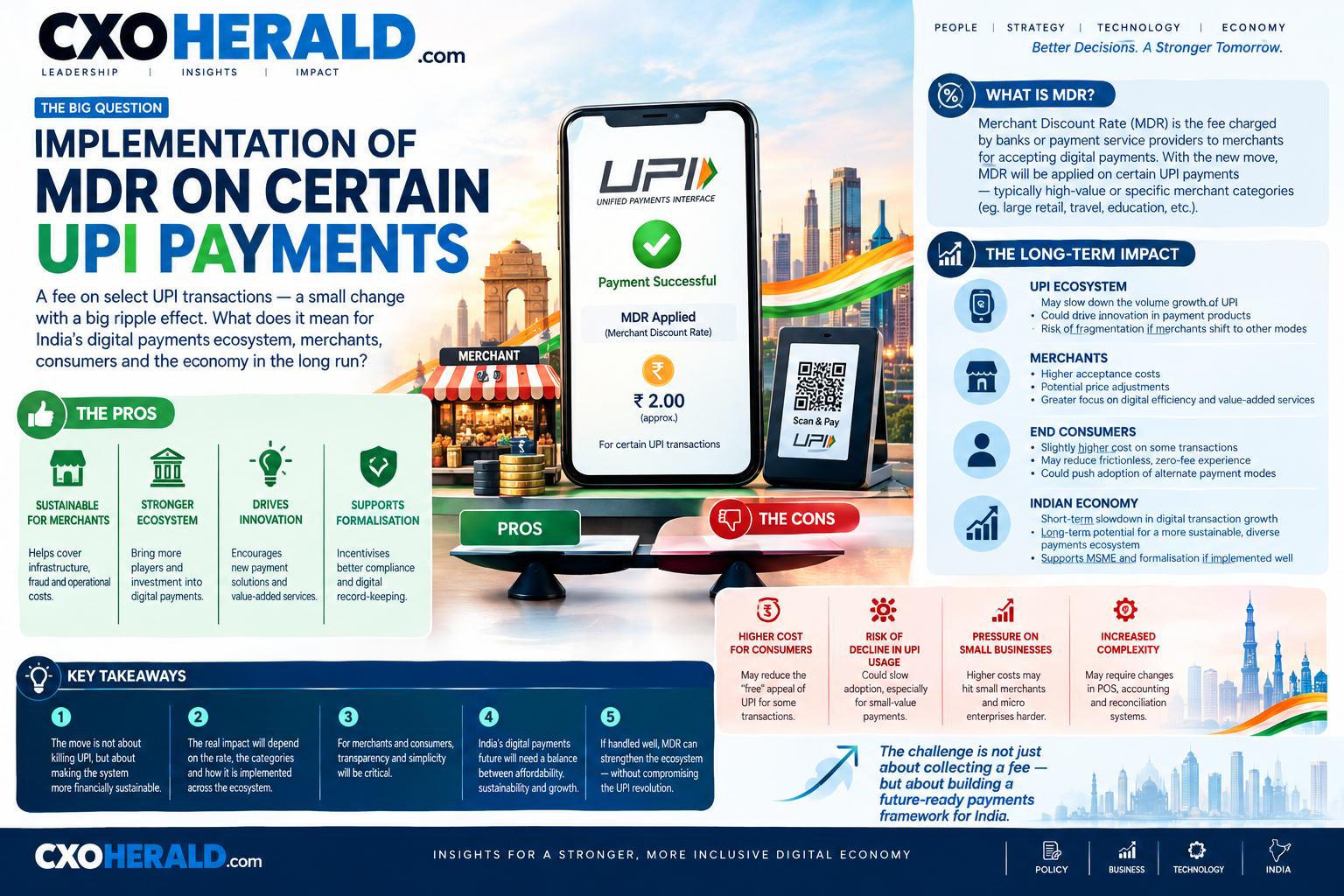
The key point is that India is not introducing a blanket UPI fee. From 15 October 2026, the new framework introduces MDR only for specified person-to-merchant (P2M) transactions above ₹2,000, while P2P remains free and small merchants covered by the P2PM framework remain protected. The headline rate is 0.4%, with a ₹300 cap for transactions of ₹75,000 and above; specified essential sectors above ₹2,000 have a ₹5 flat MDR, while capital-market payments have 0.02% MDR capped at ₹300. The government says roughly 96% of P2M transactions will remain unaffected. (Press Information Bureau)
That distinction matters enormously when assessing the long-term consequences.
MDR on Selected UPI Payments: What It Means for India’s Digital Payments Economy?
1. The policy in one view
| Category | New treatment |
|---|---|
| UPI P2P | Free |
| P2M up to ₹2,000 | Zero MDR |
| Small merchants under P2PM framework | Zero MDR |
| Specified P2M above ₹2,000 | 0.4% MDR |
| Transactions ≥ ₹75,000 | 0.4%, capped at ₹300 |
| Essential/thin-margin sectors above ₹2,000 | ₹5 flat MDR |
| Capital markets | 0.02%, capped at ₹300 |
| Consumer paying UPI MDR | No |
| Implementation | 15 October 2026 |
The government explicitly says MDR is an ecosystem charge rather than a government tax and that it is distributed among participants such as banks and payment-app providers. (Press Information Bureau)
This is therefore better understood as a revenue-model change for the UPI ecosystem, rather than a consumer transaction tax.
2. Why has India done this?
There is a structural problem behind the decision.
UPI has become enormous.
NPCI’s August 2026 statistics show approximately 24.51 billion UPI transactions worth ₹29.82 lakh crore in a single month, with 752 banks live on the network. (NPCI)
Yet for years, the merchant-payment side of UPI operated under a zero-MDR framework.
That created an unusual economic model:
Massive transaction infrastructure + enormous usage + very limited direct merchant-payment revenue.
The government previously compensated ecosystem participants through incentive schemes. Between FY2021-22 and FY2024-25, government support for UPI/RuPay incentives was approximately ₹8,730 crore, according to a 2025 parliamentary answer. (Digital Sansad)
The policy argument is therefore essentially:
UPI has become too important and too large to depend indefinitely on government-funded incentives as its primary economic support mechanism.
The August 2026 government statement explicitly described the legislative change as an enabling mechanism for long-term sustainability, technological investment, competition and resilience. (Press Information Bureau)
3. The strongest argument IN FAVOUR of MDR
A. It creates an economic model for UPI
This may ultimately be the most important consequence.
A payment network needs continual investment in:
- cybersecurity
- fraud prevention
- transaction processing
- uptime
- dispute management
- authentication
- infrastructure
- merchant acquisition
- innovation
- international expansion.
As UPI scales, those costs don’t disappear.
A zero-MDR model effectively separates usage growth from monetisation.
MDR reconnects the two.
That could make UPI less dependent on government incentives over time.
Long-term implication
The question changes from:
“How does the government keep subsidising UPI?”
to:
“Can UPI generate enough economic value within its ecosystem to sustain itself?”
That is potentially a major structural improvement.
4. It could strengthen the economics of banks and payment providers
This is an underappreciated issue.
UPI is used by consumers as though it were a free utility.
But banks and payment providers still incur costs.
The government itself has argued that the ecosystem needs a sustainable revenue model as transaction volumes expand and investment requirements increase. (Press Information Bureau)
MDR creates a revenue pool that can potentially support:
banks → PSPs → TPAPs → infrastructure → merchant acceptance → innovation
If appropriately distributed, this could encourage more investment in:
- better fraud detection
- faster dispute resolution
- merchant tools
- analytics
- reconciliation
- enterprise payment infrastructure
- cross-border UPI.
5. It may actually improve UPI reliability
This is one of the potentially positive second-order effects.
India’s digital economy increasingly depends on UPI.
If UPI goes down, the problem isn’t merely that someone can’t pay for lunch.
It can affect:
- commerce
- transport
- e-commerce
- financial services
- subscriptions
- government services
- small businesses.
More sustainable economics could support greater spending on resilience and redundancy.
The 2025 government incentive scheme itself linked incentives to banks maintaining high system uptime and low technical decline rates. (Press Information Bureau)
So monetisation and reliability are not necessarily opposing objectives.
6. But there is a serious downside: the economics of the merchant change
Consider a merchant receiving a ₹10,000 UPI payment.
At 0.4%:
MDR = ₹40
On a ₹50,000 transaction:
MDR = ₹200
On ₹75,000:
MDR = ₹300
And above ₹75,000, the cap means the effective percentage falls.
For a business operating at a 3% net margin, ₹40 may not look significant.
But payment costs accumulate across thousands of transactions.
This is especially relevant for:
- restaurants
- retailers
- electronics
- jewellery
- healthcare
- professional services
- education
- travel
- small online businesses.
The effect therefore isn’t simply “0.4%”.
It is:
0.4% × the merchant’s eligible UPI revenue
7. Small merchants are the biggest policy test
The government has deliberately protected small merchants.
The P2PM framework covers small merchants receiving up to ₹1 lakh per month through UPI, and the government says these merchants will retain zero MDR. (Press Information Bureau)
That is important because UPI’s transformative effect in India has partly come from zero-cost QR acceptance.
A vegetable vendor, taxi driver, neighbourhood shop or small trader can accept digital payment without:
- a POS machine
- a card terminal
- a monthly terminal rental
- complex onboarding.
That feature should be preserved.
If MDR were applied indiscriminately, it could weaken one of UPI’s most important economic advantages.
8. The real danger is not the 0.4% itself
The bigger danger is what happens next.
Today’s framework is targeted.
Tomorrow’s framework could potentially be expanded.
This is where merchants and investors will pay attention.
If the market starts believing:
₹2,000 today → lower threshold tomorrow → broader MDR later
then businesses may begin changing behaviour even before the economics actually become material.
Policy credibility matters.
A targeted MDR regime can be relatively benign.
An unpredictable MDR regime could create uncertainty.
9. Consumer impact: probably limited initially
For consumers, the immediate policy impact is intentionally small.
The government says:
- P2P remains free
- P2M transactions up to ₹2,000 remain free
- consumers are not supposed to be charged MDR
- merchants are not supposed to pass the MDR directly to consumers. (Press Information Bureau)
That means the typical consumer buying:
- groceries
- food
- medicine
- local services
- everyday products
will frequently experience no visible difference.
This is an important design feature.
10. But consumers can still pay indirectly
This is where economic analysis becomes more nuanced.
A merchant may not legally add:
“UPI charge: ₹40”
But the merchant has other economic choices.
They could:
- increase prices
- offer discounts for cash
- offer discounts for certain payment methods
- reduce promotional benefits
- absorb the cost by accepting lower margins.
Therefore:
No direct consumer charge ≠ zero consumer economic impact.
The incidence could gradually move from:
payment provider → merchant
and then potentially from:
merchant → consumer
through pricing.
Whether that happens materially will depend on competition.
11. UPI versus cards becomes an interesting competitive question
This could be one of the biggest long-term consequences.
For years, merchants have often preferred UPI because:
UPI = low-friction + QR + zero MDR
while cards have historically involved merchant fees.
Now eligible UPI payments above ₹2,000 acquire a cost.
That potentially changes the relative economics.
For some merchants:
UPI MDR 0.4%
could still be attractive relative to traditional card acceptance economics.
The new framework is therefore not necessarily anti-UPI.
It may simply narrow UPI’s cost advantage over other payment instruments.
The historical NPCI framework had already recognised MDR as part of the economics of merchant payments; in 2019 NPCI had set UPI MDR at up to 0.30%, before the zero-MDR regime took effect. (NPCI)
12. Could merchants return to cash?
Potentially—but this is likely to be highly uneven.
A small retailer processing ₹10,000 of eligible UPI transactions doesn’t suddenly have a massive incentive to abandon UPI.
But consider a merchant with:
₹50 lakh/month eligible UPI volume
At 0.4%, the theoretical MDR exposure is:
₹20,000/month
That becomes meaningful.
For businesses operating on very thin margins, even small percentage costs matter.
Retail organisations have already raised concerns that additional payment costs could encourage some businesses to reconsider digital acceptance. (Reuters)
The important point is:
The behavioural response will vary by merchant economics.
13. The ₹2,000 threshold creates an interesting behavioural incentive
This is one of the most fascinating consequences.
Suppose a ₹5,000 purchase attracts MDR.
A merchant might be tempted to say:
“Pay ₹2,000 by UPI and the rest by cash.”
Or:
“Cash price ₹5,000; UPI price ₹5,020.”
Or potentially structure transactions differently.
That creates a new compliance and monitoring challenge.
A threshold-based system is easy to understand but can also create threshold effects.
The ecosystem will need strong monitoring to prevent artificial transaction splitting or other forms of circumvention.
14. There is another issue: transaction fragmentation
If merchants and consumers start splitting large transactions into multiple smaller payments, UPI may see:
- higher transaction counts
- lower average ticket size
- more reconciliation complexity
- more fraud-monitoring requirements.
Paradoxically, a policy intended to create revenue could also create incentives that change transaction behaviour.
That doesn’t mean fragmentation will become widespread.
But it is something banks, NPCI and regulators will need to watch.
15. The fintech ecosystem could be one of the biggest beneficiaries
For payment companies, zero MDR has historically created a difficult monetisation environment.
They can acquire enormous numbers of users but cannot necessarily monetise every merchant transaction.
That has encouraged alternative business models.
MDR creates another potential revenue stream.
That could improve the economics of:
- payment apps
- merchant acquiring
- payment gateways
- enterprise payment platforms
- reconciliation providers
- fraud technology
- merchant analytics.
It could ultimately make the UPI ecosystem more investable.
16. But there is a risk of consolidation
This is a major concern.
Large payment platforms and banks can potentially absorb lower margins more easily than smaller players.
If payment economics become more important, scale could become increasingly valuable.
That could result in:
more consolidation → fewer economically viable smaller players → greater concentration
The policy therefore has to balance:
sustainability vs competition.
If MDR simply strengthens the largest participants, the ecosystem could become less diverse.
17. Credit-linked UPI is a separate story
This distinction is critical.
The new MDR framework applies to direct bank-account-to-merchant UPI transactions.
Credit-linked UPI products—such as RuPay credit cards linked to UPI and pre-sanctioned bank credit lines—are governed separately under the relevant credit-product framework. (Moneycontrol)
This means India effectively has different economics depending on the funding source behind the UPI transaction.
That could become strategically important.
The future UPI ecosystem may increasingly involve:
bank account → UPI
credit card → UPI
credit line → UPI
wallet → UPI
Each could have different economics.
18. What does it mean for India’s digital-payment adoption?
Short term
Potentially modest behavioural disruption.
Medium term
Merchants will experiment with payment-method preferences.
Long term
The impact depends on whether MDR remains:
low + predictable + targeted
or becomes:
higher + broader + unpredictable.
If the former happens, UPI’s adoption may remain strong.
If the latter happens, the zero-friction nature that helped UPI become ubiquitous could gradually weaken.
19. The macroeconomic impact could actually be positive
This is where the discussion gets more interesting.
A sustainable payment infrastructure can contribute to:
- formalisation
- transaction traceability
- lower cash-handling costs
- improved business records
- easier tax compliance
- financial inclusion
- credit underwriting
- merchant digitisation.
India’s 2025 government policy explicitly connected digital payments with formalisation and a less-cash economy. (Press Information Bureau)
If MDR enables the UPI ecosystem to invest more without requiring ever-larger public subsidies, that could ultimately improve the economics of India’s digital infrastructure.
20. But there is an opportunity cost
Government incentives previously supported the ecosystem.
The government paid approximately ₹8,730 crore in incentives over FY2021-22 through FY2024-25. (Digital Sansad)
Moving toward MDR shifts part of that economic burden.
Instead of:
Taxpayer → government → payment ecosystem
the model becomes more:
Merchant payment activity → MDR → ecosystem participants
That can be economically more self-sustaining.
But it also means the cost of the payment infrastructure is increasingly borne by commercial participants.
The policy question is therefore not:
“Is MDR good or bad?”
It is:
“Who should pay for the infrastructure that enables India’s digital commerce?”
21. Impact by stakeholder
| Stakeholder | Potential benefit | Potential risk |
|---|---|---|
| Consumers | UPI largely remains free | Indirect price increases |
| Small merchants | Mostly protected | Classification/compliance issues |
| Large merchants | Predictable payment cost | Margin pressure |
| Banks | New revenue pool | Operational complexity |
| Fintech/TPAPs | Potential monetisation | Greater competition/concentration |
| Payment processors | Better economics | Higher compliance burden |
| NPCI | More sustainable ecosystem | Must manage incentives carefully |
| Government | Less dependence on subsidy | Political/consumer sensitivity |
| Economy | More sustainable digital infrastructure | Possible friction in high-value digital commerce |
22. The most important issue: who actually receives the MDR?
This deserves close scrutiny.
MDR is not simply “money paid to NPCI.”
The framework says the MDR is distributed among ecosystem participants, including banks, payment service providers and application providers. (Press Information Bureau)
That creates a second policy question:
Is the MDR large enough to create meaningful incentives for everyone?
If it is too low:
merchant → ₹40
but after distribution among participants, individual economics may remain weak.
If it is too high:
merchant economics suffer.
So the success of the framework depends heavily on how the 0.4% is economically distributed.
23. My assessment of the long-term pros and cons
Potential long-term advantages
1. UPI becomes financially sustainable
Less dependence on government incentives.
2. More investment
Potentially greater spending on security, resilience and innovation.
3. Better merchant infrastructure
Payment providers have stronger incentives to develop merchant services.
4. More sophisticated fintech business models
UPI becomes a platform with sustainable commercial economics.
5. Stronger globalisation
A sustainable UPI infrastructure could support international expansion.
6. Greater innovation
Revenue creates room for new payment products and services.
7. Reduced fiscal burden
The government may not need to indefinitely compensate ecosystem participants.
Potential long-term disadvantages
1. Merchant cost inflation
Especially for high-value transactions.
2. Possible price increases
Merchants may indirectly transfer costs.
3. Cash reversion at the margin
Some low-margin businesses may reconsider digital acceptance.
4. Payment fragmentation
Merchants could encourage different payment methods.
5. Concentration
Large players may benefit disproportionately from scale.
6. Compliance complexity
Thresholds and multiple MDR regimes increase operational requirements.
7. Trust risk
Any future expansion of MDR could trigger consumer/merchant concern.
8. Reduced UPI cost advantage
The strongest differentiator versus cards may narrow.
24. The biggest strategic question isn’t MDR
It is this:
Can India monetise UPI without damaging what made UPI successful?
UPI’s success has been built on several characteristics:
Open
Interoperable
Instant
Low friction
Widely accepted
Extremely inexpensive
The policy challenge is preserving those characteristics while creating a sustainable commercial model.
That is difficult—but not impossible.
25. Three possible scenarios
Scenario A — Sustainable monetisation
MDR remains low and targeted.
Revenue funds:
- infrastructure
- cybersecurity
- merchant services
- innovation
- resilience.
Consumers continue experiencing UPI as effectively free.
Result: UPI evolves from a subsidised public digital rail into a sustainable commercial ecosystem.
Scenario B — Merchant resistance
Eligible merchants begin viewing UPI as another payment cost.
Some encourage:
- cash
- cards
- bank transfers
- alternative payment mechanisms.
UPI remains dominant but loses some of its cost advantage.
Result: digital payments continue growing, but merchant behaviour becomes more fragmented.
Scenario C — MDR expansion
The ₹2,000 threshold gradually becomes less important and more categories attract charges.
That would fundamentally change the economics of UPI.
The risk here isn’t simply higher cost.
It is that the psychological contract around UPI changes.
For years, Indians have internalised:
“UPI is free.”
If that changes materially, consumer and merchant behaviour could change faster than the actual financial cost would suggest.
26. What policymakers should watch
Over the next 12–24 months, I would track six indicators.
1. UPI volume growth
Does transaction growth accelerate, remain stable or slow?
2. Average ticket size
Do merchants change transaction patterns around ₹2,000?
3. Merchant acceptance
Are large and medium merchants continuing to actively promote UPI?
4. Cash usage
Does cash regain share in eligible merchant transactions?
5. Consumer pricing
Do businesses begin differentiating prices based on payment method?
6. Competition
Does MDR strengthen a broad ecosystem or primarily benefit the largest banks/payment apps?
These will tell us far more about the success of the policy than the headline 0.4% figure.
Bottom line
The introduction of targeted UPI MDR is neither inherently a threat to India’s digital-payment revolution nor automatically a positive reform. Its outcome will depend on design, enforcement and what happens next.
The strongest argument for MDR is that UPI has reached a scale where a sustainable economic model is increasingly necessary. India cannot indefinitely build critical digital infrastructure whose operating economics depend primarily on government incentives. The new framework attempts to introduce monetisation while protecting P2P payments, small merchants and low-value transactions. (Press Information Bureau)
The strongest argument against it is that UPI’s extraordinary adoption was partly enabled by its near-zero-cost proposition. Even a small merchant cost can alter behaviour at the margin, and the bigger concern is whether today’s targeted MDR becomes tomorrow’s broader payment charge.
So the most consequential question for India isn’t:
“Will UPI survive MDR?”
It almost certainly remains an enormous and deeply embedded payment rail.
The more important question is:
Can India create a commercially sustainable UPI without undermining the affordability, openness and frictionless merchant acceptance that made UPI one of the country’s most consequential digital-infrastructure successes?
That is the policy experiment now beginning on 15 October 2026. (The Economic Times)
And because UPI processed 24.5 billion transactions worth nearly ₹29.8 lakh crore in August 2026 alone, even small behavioural changes can have economy-wide consequences. (NPCI)
One final caveat: the framework is already attracting legal and industry scrutiny. A PIL has been filed in the Supreme Court challenging the new MDR regime, while retailer and financial-sector groups have raised concerns about merchant economics and implementation. Those are contested developments, not settled findings, and the legal position could evolve. (indianexpress.com)