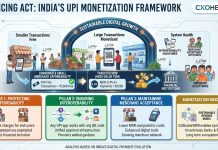
The latest government framework says P2P remains free, roughly 96% of P2M transactions remain unaffected, and MDR applies only to specified merchant transactions above ₹2,000. (Press Information Bureau)
India’s next UPI challenge is no longer adoption. It is building a sustainable economic model without compromising the simplicity, affordability and universality that made digital payments a national habit.
By CXO Herald Editorial Desk
India’s Unified Payments Interface has crossed an important threshold.
It is no longer simply a digital payments innovation. It has become part of the country’s everyday economic infrastructure.
In August 2026 alone, UPI processed more than 24.5 billion transactions worth nearly ₹29.82 lakh crore, with 752 banks live on the network. (NPCI)
That scale creates a strategic question that is increasingly difficult to avoid:
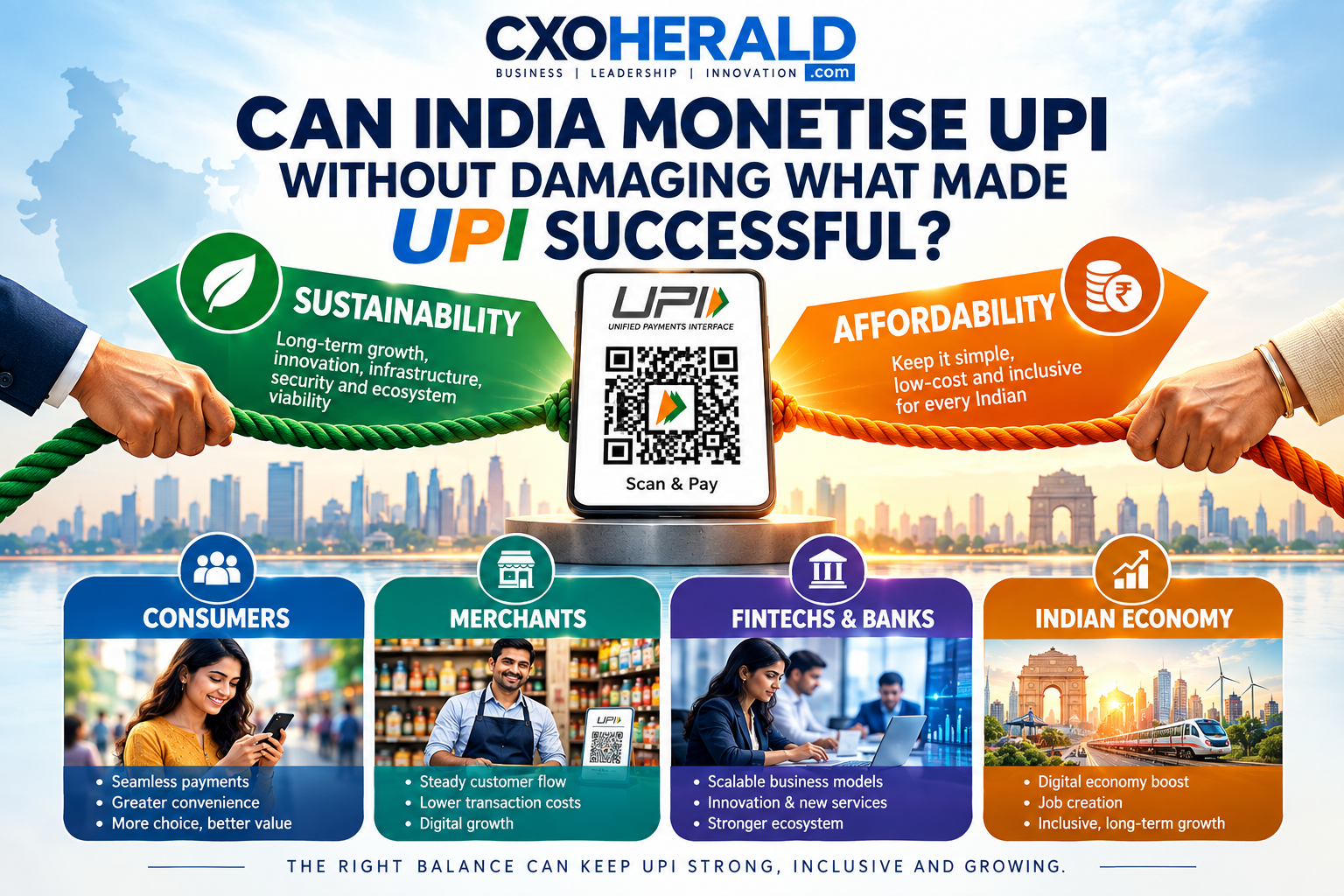
How does India monetise UPI without monetising away the very behaviour that made UPI successful?
The question has become more relevant following the government’s new Merchant Discount Rate framework.
Under the framework announced in September 2026, person-to-person transactions remain completely free. Merchant payments up to ₹2,000 also remain free, while small merchants covered under the zero-MDR framework continue to receive protection. The government estimates that approximately 96% of P2M transactions will remain unaffected. MDR applies only to specified merchant transactions above ₹2,000. (Press Information Bureau)
For qualifying transactions above that threshold, the standard MDR is 0.4%, with a cap of ₹300 for transactions of ₹75,000 and above. Essential and thin-margin sectors such as railways, telecom, insurance, fuel and agricultural inputs have a flat ₹5 MDR, while specified capital-market transactions carry a 0.02% MDR capped at ₹300. (Press Information Bureau)
The stated objective is straightforward: create a more sustainable economic foundation for the payment ecosystem while protecting consumers and small merchants.
But the strategic issue is larger than the MDR rate itself.
It is about what kind of digital public infrastructure India wants UPI to become over the next decade.
UPI’s Original Advantage Was Not Just Technology
UPI succeeded because it removed friction.
Consumers did not need to understand payment rails, settlement arrangements or merchant-acquiring economics. They simply scanned a QR code, entered an amount and paid.
For merchants, particularly small businesses, the proposition was equally powerful: accept digital payments without the complexity and cost traditionally associated with card infrastructure.
That simplicity helped transform UPI from a technology platform into a behavioural platform.
The challenge with monetisation is therefore not whether a 0.4% MDR is economically significant in isolation.
It is whether repeated small changes to the payment experience could eventually alter user and merchant behaviour.
That distinction matters.
A payment system can remain technically interoperable while becoming economically or operationally less frictionless.
The real test of monetisation will therefore be measured not simply in MDR collections, but in whether transaction growth, merchant acceptance and consumer trust remain intact.
The Case for Monetisation
There is a legitimate economic argument for creating sustainable revenue streams around UPI.
Running a payments ecosystem at India’s current scale requires continuous investment in:
- Cybersecurity
- Fraud detection
- Cloud and network infrastructure
- Transaction reliability
- Authentication systems
- Customer support
- Risk management
- Rural and semi-urban expansion
- Product innovation
UPI’s transaction volumes have reached a scale where infrastructure resilience is no longer a back-office consideration. It is an economic necessity.
The government’s own August 2026 explanation of the legislative framework cited the need for long-term sustainability, technological advancement and resilience against emerging risks. (Press Information Bureau)
A sustainable revenue model could also reduce excessive dependence on government-supported incentives.
That matters because India’s digital payments story has historically involved significant public-policy support.
For example, the government approved a ₹1,500 crore incentive scheme for low-value BHIM-UPI P2M transactions for FY2024-25, including incentives intended to encourage small-merchant adoption. (Press Information Bureau)
The long-term question is therefore not whether UPI should generate revenue.
It is whether the ecosystem can generate revenue without making the payment experience materially worse.
The Merchant Question Is More Important Than the MDR Percentage
For large businesses, a 0.4% payment cost may be manageable.
For a high-margin business, it may be absorbed as part of the cost of accepting digital payments.
For a thin-margin business, however, every basis point matters.
This is why the differentiated treatment of essential and thin-margin sectors is strategically significant.
The new framework provides a flat ₹5 MDR for specified sectors including railways, telecom, insurance, fuel and agricultural inputs for transactions above ₹2,000. (Press Information Bureau)
The policy logic is clear: payment economics cannot be separated from industry economics.
But another issue will determine how merchants respond:
The framework states that customers should not be charged MDR and that banks have been advised to ensure merchants do not pass the cost to consumers. UPI application providers are also prohibited from imposing platform fees or hidden charges. (Press Information Bureau)
The policy therefore establishes an important principle:
Monetisation should occur inside the payment ecosystem, not at the point where consumers experience UPI as a simple payment habit.
That principle will need careful monitoring as implementation develops.
The Biggest Risk Is Not the Fee. It Is Complexity.
One of UPI’s greatest strengths is that users rarely need to think about the underlying economics.
That could change if monetisation creates multiple categories, exceptions, thresholds, settlement arrangements and merchant classifications.
The more complicated the backend becomes, the greater the possibility of:
- Incorrect transaction tagging
- Billing disputes
- Reconciliation problems
- Merchant confusion
- Different treatment across payment categories
- Operational friction between banks, PSPs, merchants and applications
This is particularly relevant because the ecosystem already contains multiple payment instruments and credit-linked variants.
The success of the MDR framework will therefore depend heavily on operational simplicity behind the scenes.
Consumers should ideally experience no additional complexity.
Monetisation Could Create a New UPI Business Model
There is another way to look at the issue.
UPI does not necessarily have to become valuable simply because every transaction generates a fee.
The larger opportunity may be to monetise the ecosystem surrounding transactions.
Payments generate data and business signals.
With appropriate privacy, consent and regulatory safeguards, those signals can support:
Merchant intelligence
Businesses can understand transaction patterns, peak periods and customer behaviour.
Reconciliation
Automated reconciliation can reduce accounting effort and errors.
Fraud prevention
Real-time transaction intelligence can support more sophisticated fraud detection.
Working-capital finance
Consistent digital cash flows can potentially strengthen underwriting for eligible businesses.
Embedded financial services
Payments can become the entry point for insurance, credit, savings and other financial products.
Enterprise payment infrastructure
Large businesses can pay for advanced treasury, reconciliation, reporting and risk-management services.
This creates a fundamentally different monetisation philosophy:
Don’t charge people for the habit. Build businesses around the infrastructure that the habit creates.
UPI Is Also an Economic Formalisation Engine
The impact of UPI extends beyond payments.
Digital transactions create records.
Those records can help businesses demonstrate cash flows, improve accounting visibility and potentially strengthen access to formal financial services.
For smaller businesses, digital payment acceptance can become part of a broader transition from informal commerce toward formal financial participation.
That means the economics of UPI should not be measured exclusively by payment-industry revenue.
They should also be assessed against broader outcomes:
Are more merchants accepting digital payments?
Are transactions becoming more reliable?
Is fraud falling?
Is access expanding beyond major cities?
Are small businesses benefiting from better financial visibility?
Is the consumer experience becoming easier rather than harder?
These are the metrics that ultimately determine whether monetisation strengthens or weakens the digital-payments ecosystem.
The Strategic Choice: Monetise the Ecosystem, Not the Habit
There are two very different approaches to monetisation.
The first is transaction-centric:
More transactions = more fees.
The second is ecosystem-centric:
More transactions = more infrastructure, data, services and financial opportunities.
The second model may prove more compatible with UPI’s original architecture.
A payment network becomes more valuable as more people and businesses use it.
That network effect should not be unnecessarily disrupted.
Instead, the ecosystem can build higher-value commercial services around the underlying payment infrastructure.
This is particularly important because UPI’s greatest strategic asset is not the QR code.
It is trust at scale.
Consumers trust that a QR code will work across applications.
Merchants trust that customers can pay regardless of which participating bank or application they use.
Businesses trust the network to process enormous volumes in real time.
Any monetisation strategy must therefore protect the invisible infrastructure of trust.
What CXOs Should Watch
For business leaders, the next phase of UPI should be viewed through five lenses.
1. Payment economics
Companies should understand how MDR affects their effective payment costs across transaction categories rather than treating UPI as a single uniform channel.
2. Customer behaviour
Businesses should monitor whether customers change payment methods when transaction values cross thresholds.
3. Merchant strategy
Large enterprises should assess whether MDR becomes part of payment-acquiring negotiations, commercial pricing or treasury strategy.
4. Technology and reconciliation
Finance and technology teams will need strong transaction classification, reconciliation and reporting capabilities.
5. Fraud and risk
As payment volumes and monetisation increase, fraud management becomes increasingly strategic rather than merely operational.
For CFOs, CIOs, CTOs and digital leaders, UPI is increasingly part of the company’s core financial infrastructure.
The Bigger Picture
India has already solved one of the hardest problems in digital payments:
How do you get hundreds of millions of people and millions of businesses to use a common digital payment system at extraordinary scale?
The next challenge is more subtle:
How do you make that system economically sustainable without making it economically unattractive?
The September 2026 framework attempts to draw that line by keeping P2P free, protecting low-value merchant transactions and small merchants, while introducing MDR for a defined portion of higher-value merchant payments. (Press Information Bureau)
Whether that balance works will depend less on the headline rate and more on implementation.
If UPI remains fast, interoperable, reliable and effectively frictionless for consumers, monetisation could help strengthen the ecosystem.
If costs, complexity or uncertainty begin to alter merchant and consumer behaviour, the economic benefits could become harder to realise.
That makes the next phase of UPI less about charging for payments and more about designing the economics of digital public infrastructure.
CXOHerald.com Takeaway
India does not need to choose between a free UPI and a sustainable UPI.
The more important question is where monetisation happens.
The strongest model is likely to be one that protects the basic payment experience while creating sustainable economics around the infrastructure, enterprise services, financial products, risk management and innovation that sit on top of it.
UPI became powerful because it made digital payments feel almost invisible.
Its next decade will depend on ensuring that monetisation does not make that simplicity visible.
The strategic principle is simple: monetise the ecosystem, not the habit.
For India, that may be the difference between merely having the world’s largest real-time payment system and building one of the world’s most economically sustainable digital financial infrastructures.
Source note: This analysis reflects the UPI/MDR framework announced in September 2026 and available public data as of 18 September 2026. Implementation details and market responses may evolve.