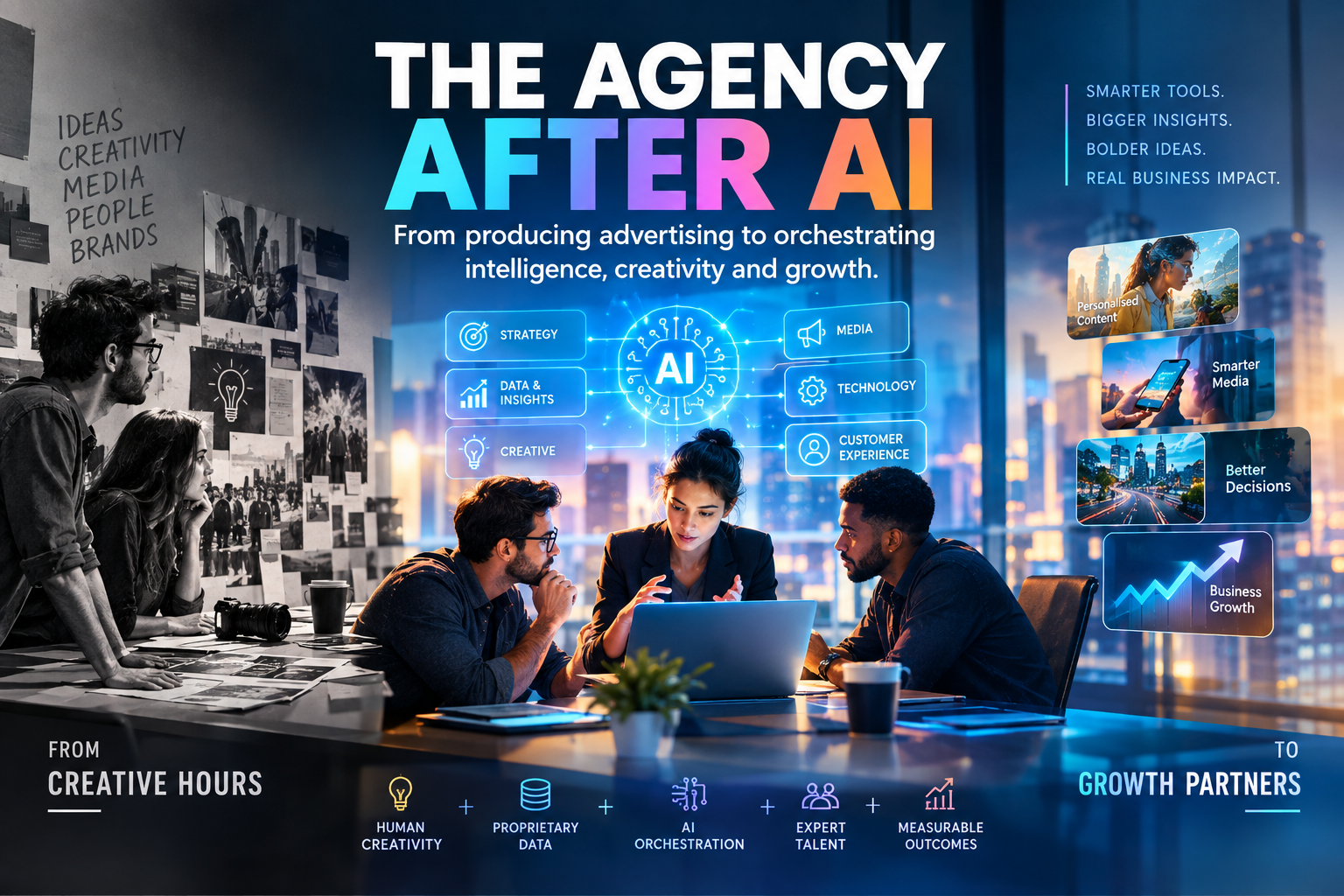
From producing advertising to orchestrating intelligence, creativity and growth.
From selling creative hours to becoming indispensable growth partners: why agencies must reinvent their value proposition as AI transforms advertising, media, content and marketing.?
By CXO Herald Editorial Team
Artificial intelligence has created an uncomfortable question for the advertising, creative and media industry:
If a client can use ChatGPT, generative AI, image models, video generators, media-planning tools and increasingly autonomous AI agents to produce work faster and cheaper, what exactly should an agency be paid for?
The answer cannot simply be more content.
AI has already made content production dramatically easier. It can generate headlines, scripts, storyboards, images, videos, media-plan variations, audience segments, research summaries and campaign concepts in minutes.
The technology is changing the economics of production.
But advertising has never been only a production business.
Its deeper value lies in understanding people, brands, culture, markets and businesses—and connecting those things through ideas that create attention, preference, trust and ultimately growth.
That distinction could determine which agencies remain strategically important in the AI era.
Cindy Rose, CEO of WPP, has put the challenge directly. In WPP’s 2026 strategic report, she wrote:
“In the era of AI our role will become more – not less – important.”
But she also acknowledged that the industry is becoming more fragmented and complex. WPP’s response has been to reorganise around integrated media, creative, production and enterprise solutions, powered by its WPP Open platform.
The implication is profound.
Agencies cannot compete with AI by trying to become better AI factories. They have to become better at solving the problems that AI alone cannot own.
AI Is Not Killing Advertising. It Is Changing What Gets Paid For.
The first mistake agencies can make is treating AI as simply another production tool.
It is much bigger than that.
AI is changing:
- how ideas are generated;
- how campaigns are produced;
- how audiences are identified;
- how media is planned;
- how content is personalised;
- how creative performance is measured;
- how consumers discover brands;
- how agencies are staffed;
- how clients procure marketing services;
- and potentially how agencies charge for their work.
The Interactive Advertising Bureau’s 2025 State of Data research found that only 30% of agencies, brands and publishers had fully integrated AI across the media campaign lifecycle at that point, while half of those not yet fully integrated expected to do so by 2026.
The same research identified data quality, data protection and fragmented technology as major barriers.
In other words, the industry is not merely facing a creativity problem.
It is facing an operating-model problem.
The Production Advantage Is Disappearing
Historically, agencies possessed capabilities that were difficult for clients to replicate.
They had:
- art directors;
- copywriters;
- film crews;
- editors;
- designers;
- photographers;
- animators;
- media planners;
- researchers;
- strategists;
- production houses.
AI is democratising access to many of these capabilities.
A small brand can now generate campaign concepts, product images, social posts and video variations without commissioning a traditional production process.
That means agencies cannot build their future around scarcity of execution.
Execution is becoming abundant.
And when supply becomes abundant, the economic value of execution generally declines.
This is why the central agency question is no longer:
“How much creative work can we produce?”
It is:
“What valuable business problem can we solve that becomes more important because AI has made production abundant?”
The End of the Agency as a Content Factory
Generative AI could make the old agency model increasingly difficult to defend.
Imagine a traditional workflow:
Brief → Strategy → Concept → Copy → Design → Production → Adaptations → Media → Reporting
AI can accelerate almost every stage.
The agency therefore needs to move upstream and downstream.
Upstream
- business strategy;
- consumer insight;
- brand architecture;
- cultural intelligence;
- positioning;
- product strategy;
- customer experience;
- growth strategy.
Downstream
- commerce;
- customer experience;
- CRM;
- personalisation;
- measurement;
- experimentation;
- conversion;
- marketing technology;
- revenue optimisation.
The middle—pure production—will increasingly be automated, augmented or commoditised.
The agency of the future therefore needs to occupy more of the problem-solving space.
“Creativity” Will Matter More—But Creative Craft Will Change
There is a paradox at the heart of AI.
As AI makes content easier to produce, original ideas may become more valuable, not less.
David Droga, the advertising creative leader who became CEO of Accenture Song and later vice chair of Accenture, has argued that:
“Creativity is a game changer. That’s true of society, in advertising and in life.”
That idea becomes particularly relevant when machines can produce thousands of competent variations.
If everyone can produce competent advertising, competent advertising stops being a competitive advantage.
The scarce resource becomes:
the idea worth producing.
AI can generate 1,000 executions.
It cannot automatically tell a brand which one deserves to exist.
That remains a strategic and cultural judgement.
The New Creative Director Is Part Artist, Part Editor, Part Systems Thinker
The creative leader of the AI era will need a different skill set.
Traditional creative leadership emphasised:
- taste;
- storytelling;
- visual thinking;
- copy;
- cultural observation;
- craft.
Those skills remain relevant.
But they increasingly need to be combined with:
- AI literacy;
- prompt design;
- model selection;
- data interpretation;
- rapid experimentation;
- content systems;
- synthetic production;
- intellectual-property awareness;
- brand governance.
The creative director may no longer personally create every element.
Instead, the creative leader may orchestrate humans and machines to produce a distinctive outcome.
That is a fundamental change in the definition of craft.
AI Makes “More Content” Easy. Agencies Must Make “Better Decisions” Valuable.
This may be the most important distinction.
A client does not ultimately need:
10,000 pieces of content.
It needs:
the right content, for the right audience, in the right context, at the right time, producing a measurable business result.
Arthur Sadoun, Chairman and CEO of Publicis Groupe, made this point when discussing AI-enabled production:
“Brands don’t simply need more content. They need to know what works, and crucially, why.”
Publicis has increasingly invested in connecting data, media, creativity, production and measurement.
That direction reflects a broader industry shift:
AI is moving agencies from content creation toward content intelligence.
From Creative Agency to Intelligence Partner
The agency of the future could become something closer to a marketing intelligence company with creative capabilities.
Its value stack could look like this:
Layer 1: Data
Who is the customer?
Layer 2: Intelligence
What does the customer need?
Layer 3: Strategy
What should the brand do?
Layer 4: Creativity
What idea will make people care?
Layer 5: Technology
How can the idea be personalised and deployed?
Layer 6: Media
Where should it appear?
Layer 7: Experience
What happens after the customer responds?
Layer 8: Measurement
Did it create incremental business value?
This is much harder for a generic AI tool to replace.
Media Agencies Have an Even Bigger Opportunity
AI is not only changing creative.
It is changing media.
The IAB’s 2025 research found that nearly eight in ten buyers were already using or exploring generative AI for media planning and activation.
AI can increasingly assist with:
- audience segmentation;
- media planning;
- forecasting;
- optimisation;
- budget allocation;
- creative testing;
- attribution;
- marketing-mix modelling;
- inventory selection.
That creates a difficult question for media agencies.
If platforms automate buying and AI automates planning, what remains?
The answer is independent intelligence.
A valuable media agency should increasingly help clients answer:
- Where should we invest?
- Why?
- What should we stop doing?
- What incremental value did media generate?
- How do different channels work together?
- Which audiences create profitable growth?
- How do we balance short-term conversion with long-term brand building?
The agency moves from media buying to growth orchestration.
The Real Enemy Is Not ChatGPT
It is tempting for agencies to see ChatGPT, OpenAI, Google, Adobe, Midjourney, Runway or other AI platforms as competitors.
That is only partially correct.
The bigger competitive threat is an agency that knows how to use AI better than you do.
The market will increasingly divide between:
Agencies using AI to reduce cost
and
Agencies using AI to create new client value.
Those are very different strategies.
The first produces efficiency.
The second produces differentiation.
AI Will Compress Timelines—and Client Expectations
One of the biggest changes will be speed.
A campaign that once required weeks of development may increasingly be expected within days.
A client may ask:
“Can we see 50 routes?”
The agency cannot respond:
“That will take three weeks.”
AI changes the client’s reference point.
This does not necessarily mean agencies should deliver everything instantly.
It means agencies need to become faster at exploration and more rigorous at selection.
The new workflow could become:
AI generates → humans interrogate → strategy filters → creative refines → data tests → humans decide → AI scales.
That is fundamentally different from:
Humans create → humans revise → humans produce → humans adapt.
The Agency Pitch Is Going to Change
For decades, agencies have won business through:
- credentials;
- case studies;
- creative ideas;
- chemistry;
- talent;
- pricing.
AI introduces another question:
What is your operating system?
Clients will increasingly want to know:
- Which AI platforms do you use?
- How do you protect confidential data?
- How do you validate outputs?
- How do you handle intellectual property?
- How do you maintain brand consistency?
- How do you measure AI-generated creative?
- How much time does AI actually save?
- Where does human judgement remain mandatory?
- How does your technology connect with our data and systems?
WPP’s own AI-agency framework argues that agency evaluation will increasingly transcend the traditional pitch and focus on technology integration, multidisciplinary teams, AI governance and measurable outcomes.
That is a significant change in procurement.
The Future Pitch May Be a Working Prototype
Instead of showing 30 slides explaining what an agency could do, agencies may increasingly demonstrate:
- an AI-powered campaign workflow;
- a live audience model;
- a personalised creative system;
- a working content engine;
- an agentic media workflow;
- a customer-experience prototype.
The question becomes:
“Show us the machine.”
This favours agencies that have invested in technology, data and operational integration—not just presentations.
Trust Could Become the Agency’s Most Valuable Asset
AI produces extraordinary possibilities.
It also produces extraordinary risks.
The IAB reported in 2025 that more than 70% of surveyed marketers had encountered an AI-related advertising incident, including hallucinations, bias or off-brand content.
That creates a major opening for agencies.
Clients will need help deciding:
- What can AI create?
- What should AI create?
- What must humans approve?
- What data can AI access?
- Which models can be trusted?
- What claims require verification?
- How should AI-generated advertising be disclosed?
In January 2026, IAB launched an AI Transparency and Disclosure Framework intended to help brands, agencies, publishers and platforms address responsible AI use in advertising.
The implication is important:
AI governance is becoming part of creative governance.
The Agency’s New Role: Trusted AI Orchestrator
The most valuable agency may not be the one with the largest creative department.
It may be the one that can orchestrate:
Human creativity + AI + proprietary data + media + technology + culture + measurement.
This is already visible among major agency groups.
Publicis and Microsoft expanded their partnership in 2026 to develop an AI-powered marketing solution combining legacy systems, AI agents and identity-based data.
WPP has reorganised around WPP Media, WPP Creative, WPP Production and WPP Enterprise Solutions, with WPP Open positioned as its agentic marketing platform.
Dentsu has similarly demonstrated work combining generative AI with human creativity and business-transformation capabilities.
These are not simply technology investments.
They represent an attempt to redefine what an agency is.
The Most Important Question: What Will Clients Pay For?
This is where agency leadership needs to be brutally honest.
Clients are unlikely to pay premium fees indefinitely for activities that AI can perform at commodity prices.
They will increasingly pay for:
Strategic clarity
Knowing what to do.
Creative distinction
Knowing what deserves attention.
Cultural intelligence
Knowing what will resonate.
Proprietary knowledge
Knowing something competitors don’t.
Data intelligence
Knowing which customers and behaviours matter.
AI orchestration
Knowing which tools to use and how.
Integration
Connecting fragmented marketing systems.
Measurement
Proving what created incremental value.
Accountability
Taking responsibility for the outcome.
That last point may become particularly important.
AI can generate recommendations.
Someone still needs to be accountable for the decision.
Agencies Need to Own Outcomes, Not Outputs
This could be the biggest commercial transformation.
Traditional agency language:
“We delivered 20 campaigns.”
Future agency language:
“We increased qualified demand by X.”
Traditional:
“We produced 5,000 assets.”
Future:
“We increased creative effectiveness while reducing production cost.”
Traditional:
“We delivered 10 billion impressions.”
Future:
“We generated incremental reach among high-value customers at a defined marginal cost.”
The movement is from:
Output → Outcome
And AI accelerates that transition because it makes outputs cheaper.
The Agency Talent Model Must Change
The traditional agency pyramid may become less relevant.
Instead, agencies will need what WPP describes as more multidisciplinary and “M-shaped” talent—people with deep expertise combined with meaningful capability across adjacent disciplines.
Imagine a strategist who understands:
- brand;
- data;
- AI;
- media;
- technology.
Or a creative leader who understands:
- storytelling;
- generative AI;
- culture;
- product;
- commerce.
Or a media planner who understands:
- data;
- AI;
- creative;
- measurement;
- business economics.
These hybrids could become extremely valuable.
Agencies Should Build Their Own Intellectual Property
One of the biggest mistakes agencies could make is simply becoming resellers of AI tools.
If every agency uses the same OpenAI, Google, Adobe, Anthropic or other models, where is the differentiation?
The answer must be proprietary intelligence.
That could include:
- proprietary audience models;
- industry datasets;
- cultural intelligence;
- creative-performance databases;
- brand knowledge graphs;
- proprietary AI agents;
- campaign optimisation systems;
- measurement frameworks;
- internal benchmarks;
- workflow automation;
- distinctive methodologies.
The AI model may be available to everyone.
The agency’s accumulated intelligence should not be.
The Future Agency May Look More Like a Technology Company
That does not mean every agency needs to become a software company.
It means agencies need technology fluency.
The strongest future operating model could combine:
Consultancy thinking
Creative culture
Technology capability
Media intelligence
Data infrastructure
AI orchestration
Commercial accountability
This is why the boundaries between agencies, consultancies, technology companies and marketing platforms are increasingly blurred.
But There Is a Danger: Losing the Human Idea
There is an understandable temptation to optimise everything.
AI can test.
AI can score.
AI can predict.
AI can personalise.
AI can generate.
AI can optimise.
But advertising is not only an optimisation problem.
Culture is unpredictable.
People are emotional.
Great ideas sometimes appear irrational before they become obvious.
If agencies turn creativity entirely into a performance spreadsheet, they risk producing advertising that is efficient but forgettable.
That would be a strategic failure.
The agency’s responsibility is therefore not to eliminate human creativity.
It is to use AI to give human creativity more leverage.
Human Creativity Becomes the Differentiator
Arthur Sadoun has argued that AI’s future depends on talent, while Publicis has increasingly described its model as combining human ingenuity with intelligent technology.
That is an important distinction.
AI can increase the number of possible ideas.
Humans still have to decide:
Which idea matters?
That judgement comes from:
- lived experience;
- empathy;
- cultural understanding;
- taste;
- curiosity;
- courage;
- ethics;
- imagination.
These are difficult to reduce to software.
The New Agency Formula
The agency of the AI era can be understood through a simple formula:
AI creates abundance.
Strategy creates direction.
Creativity creates differentiation.
Data creates precision.
Media creates reach.
Technology creates scale.
Humans create meaning.
That is the opportunity.
Seven Strategic Moves Agencies Should Make Now
1. Build an AI-native operating model
Do not simply give employees AI subscriptions.
Redesign workflows around AI.
Identify where AI can:
- automate;
- augment;
- accelerate;
- analyse;
- personalise.
2. Create an AI governance practice
Establish clear policies for:
- privacy;
- intellectual property;
- copyright;
- model usage;
- client data;
- disclosure;
- brand safety;
- hallucination control.
Trust will become part of the agency proposition.
3. Build proprietary intelligence
Develop assets competitors cannot easily buy.
The goal should be:
Own intelligence, don’t merely rent technology.
4. Train hybrid talent
The next generation of agency talent should understand at least two or three disciplines.
Creatives need AI.
Strategists need data.
Media teams need technology.
Technologists need culture.
Account leaders need business economics.
5. Change the commercial model
Consider moving beyond:
hours × people × markup
toward models incorporating:
- strategic retainers;
- platform fees;
- performance-linked fees;
- technology licensing;
- transformation programmes;
- outcome-based compensation where appropriate.
Not every client or assignment should use the same model.
6. Measure business outcomes
Build dashboards around:
- incremental revenue;
- customer acquisition;
- brand health;
- lifetime value;
- creative effectiveness;
- media efficiency;
- conversion;
- retention.
AI should make measurement better—not merely cheaper.
7. Become indispensable to the C-suite
The agency relationship should move beyond the CMO.
The next-generation agency should be capable of speaking to:
- CEO;
- CFO;
- CIO;
- CTO;
- CMO;
- Chief Digital Officer;
- Chief Customer Officer.
Because marketing increasingly touches the entire enterprise.
What Agencies Should Stop Doing
Stop selling AI as magic.
Clients need outcomes, not buzzwords.
Stop producing content simply because AI makes it cheap.
More content can create more noise.
Stop treating AI as an isolated innovation team.
AI needs to become part of the operating model.
Stop measuring success through volume alone.
Thousands of assets do not necessarily create value.
Stop competing solely on production efficiency.
Technology platforms will continue to compress production costs.
Stop separating creative, media, data and technology.
The customer experiences one brand.
The agency should too.
What Agencies Should Start Selling
Instead of:
Creative execution
sell:
Creative advantage
Instead of:
Media buying
sell:
Growth orchestration
Instead of:
Content production
sell:
Content intelligence
Instead of:
AI tools
sell:
AI-enabled transformation
Instead of:
Campaign reports
sell:
Business intelligence
Instead of:
Man-hours
sell:
Judgement, intellectual property and outcomes
The Competitive Battlefield Will Move Up the Value Chain
This is the central conclusion.
AI will make some agency services cheaper.
It will also make some agency services more valuable.
Likely to become more commoditised
- basic copy;
- routine design;
- simple video adaptation;
- translation;
- resizing;
- repetitive content production;
- basic research;
- standard media operations.
Potentially more valuable
- positioning;
- cultural insight;
- brand strategy;
- original creative ideas;
- customer intelligence;
- AI transformation;
- data strategy;
- experience design;
- creative effectiveness;
- business experimentation;
- measurement;
- organisational change.
The agency has to move toward the second column.
The Meaningful Agency of the Future
There is a deeper question beyond competitiveness.
Why should an agency exist?
The answer cannot simply be:
“Because brands need people to make advertisements.”
AI makes that proposition weaker.
A more durable answer is:
Because businesses need partners who understand people, culture, technology and growth—and can turn that understanding into ideas and experiences that create meaningful change.
That is a much stronger proposition.
The AI Era Does Not Eliminate the Agency. It Raises the Bar.
The advertising industry has reinvented itself many times.
Print created agencies.
Radio changed them.
Television transformed them.
Digital fragmented them.
Social media accelerated them.
Mobile made them real-time.
AI may force the most fundamental transformation yet.
But the industry’s future will not be determined by who has access to the most powerful model.
Access to models will increasingly become universal.
The differentiator will be what agencies build around the models.
Their people.
Their judgement.
Their data.
Their culture.
Their proprietary intelligence.
Their relationships.
Their ability to understand a client’s business.
Their ability to create ideas that matter.
And their willingness to be accountable for outcomes.
Cindy Rose’s formulation for WPP is instructive: the agency’s role, in her view, can become more important as marketing becomes more fragmented and complex.
The strategic implication for every independent agency and global network is straightforward:
AI is not the end of the agency.
AI is the end of the agency whose primary value is producing things that AI can produce.
The agencies that remain relevant will be those that use AI to eliminate low-value work—and then reinvest the resulting capacity into higher-value thinking.
They will not compete against machines on machine terms.
They will combine machines with the things machines do not automatically possess:
judgement, taste, context, courage, empathy, culture and imagination.
That is how an advertising, creative or media agency can remain competitive, relevant and meaningful in the age of AI.
CXO HERALD’S AGENCY TRANSFORMATION FRAMEWORK
OLD AGENCY
Brief → Idea → Campaign → Media → Report
AI-ERA AGENCY
Business problem → Data → Intelligence → Strategy → Human idea → AI augmentation → Personalisation → Media → Experience → Measurement → Business outcome
The difference is not merely technological.
It is a different definition of value.
FIVE QUESTIONS EVERY AGENCY CEO SHOULD ASK
1. What percentage of our current revenue comes from work that AI can materially commoditise?
2. What proprietary intelligence do we own that competitors cannot simply purchase?
3. Are our clients buying outputs from us—or relying on our judgement?
4. Can we connect creativity, media, data, technology and customer experience into one proposition?
5. If our clients had access to every major AI model tomorrow, why would they still need us?
The answer to the fifth question may be the most important strategy document an agency writes this decade.
FINAL WORD
The future of the agency will not be determined by whether AI can write copy, generate images or create video.
It will be determined by whether agencies can evolve from makers to orchestrators, suppliers to partners, outputs to outcomes, and execution to intelligence.
The best agencies of the AI era will not necessarily create the most content.
They will create the most consequential ideas.
And they will use AI to make those ideas faster, more relevant, more measurable and more scalable than was previously possible.
The machine will increasingly make the work.
The agency must become better at deciding what work is worth making—and why it matters.
That is where the future value of the agency lies.
Source and quotation verification
The industry’s own evidence supports the central thesis. IAB reported that only 30% of agencies, brands and publishers had fully integrated AI across the media-campaign lifecycle in its 2025 benchmark, while nearly 80% of buyers were using or exploring GenAI for media planning/activation. (IAB)
IAB’s subsequent research also found that more than 70% of surveyed marketers had encountered AI-related incidents such as hallucinations, bias or off-brand content—making governance a material agency opportunity rather than merely a compliance issue. (IAB)
WPP’s current strategy explicitly positions the company as a trusted growth partner and integrates media, creative, production and enterprise solutions around its WPP Open agentic marketing platform. Cindy Rose’s statement that the agency role could become “more – not less – important” as marketing becomes more fragmented and complex is from WPP’s 2026 strategic report. (WPP.com)
Publicis is pursuing a comparable integration of AI, data, media, creativity and production. Arthur Sadoun has said that brands need to know not simply how to generate more content, but “what works, and crucially, why”; Publicis has also expanded its Microsoft partnership to build agentic marketing capabilities. (Publicis Groupe)
David Droga’s “Creativity is a game changer” statement appears on Accenture’s brand-strategy and creative page, while Accenture’s account of his tenure describes an operating model integrating creativity, technology, design, AI, strategy and data. (Accenture)
Dentsu’s 2025 Cannes work similarly focused on the intersection of human creativity, generative AI and business transformation. (Dentsu Group)
One particularly important counterweight to AI enthusiasm is consumer trust: IAB’s 2026 research found that consumers were substantially less positive about AI-generated advertising than advertising executives were, underscoring why human judgement, transparency and brand integrity remain commercially important. (IAB)