
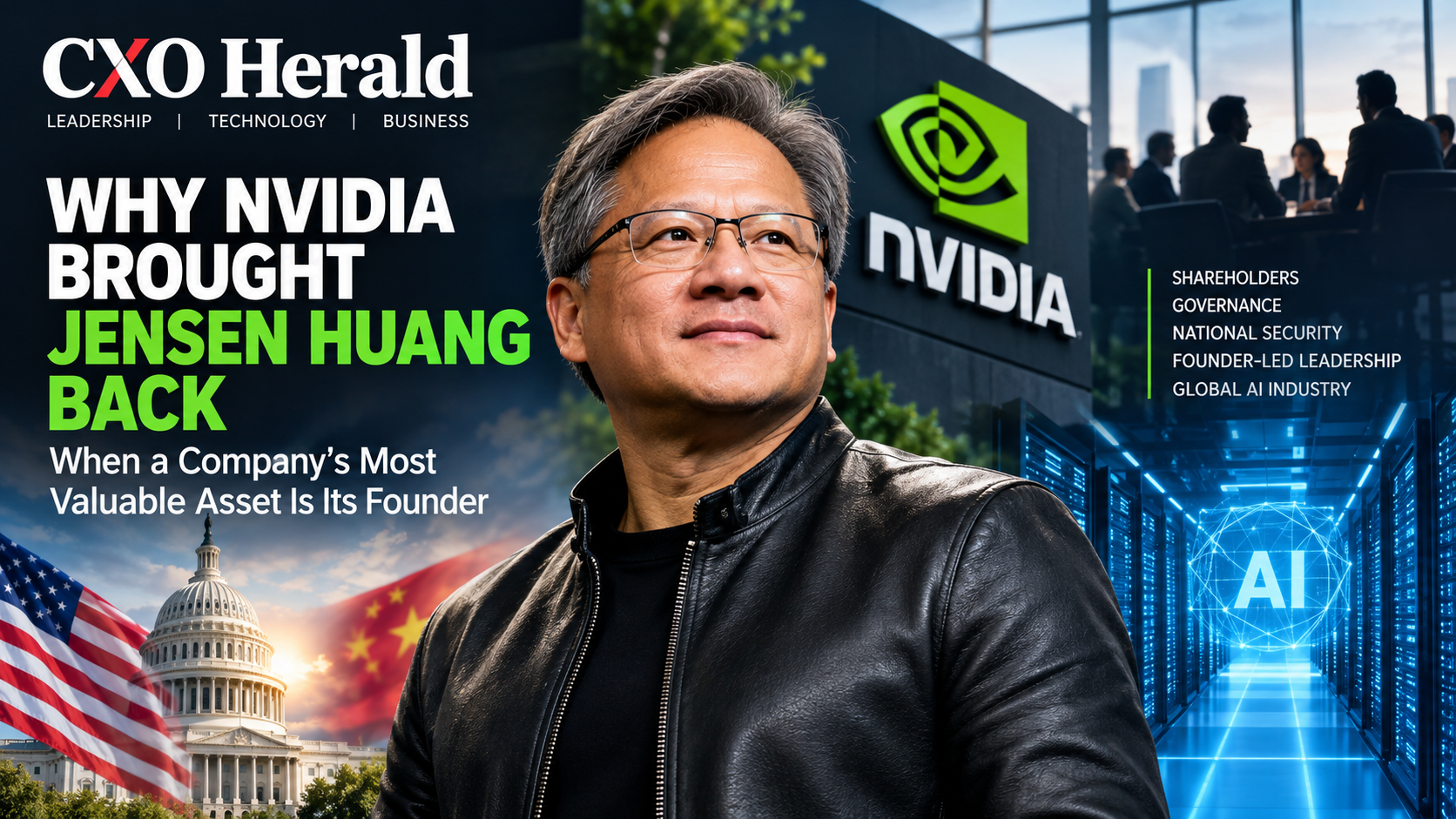
The dramatic reinstatement of Jensen Huang as NVIDIA’s CEO exposes the intersection of founder-led leadership, corporate governance, shareholder power and America’s strategic ambitions in artificial intelligence.
By CXO Herald | Leadership & Technology
In one of the most extraordinary corporate leadership reversals in recent technology history, NVIDIA has reinstated its co-founder Jensen Huang as President and Chief Executive Officer, just 11 days after his resignation. The company’s board, which had initially accepted his departure and ruled out bringing him back, has now unanimously reversed its position.
The decision raises a fundamental question for the global business community: Can a company’s dependence on its founder become so significant that even a serious leadership controversy cannot justify replacing that individual?
In NVIDIA’s case, the answer appears to be yes.
A dramatic reversal in just 11 days
The controversy began on November 12, 2026, when Huang resigned following revelations concerning his personal conduct and reported relationships, including allegations involving a businesswoman suspected by US authorities of having connections with Chinese intelligence.
NVIDIA appointed its Chief Financial Officer, Colette Kress, as interim CEO and announced that it would initiate a search for a permanent successor.
Initially, the board appeared determined to move forward without Huang. However, an increasingly vocal campaign for his return emerged across Silicon Valley, NVIDIA’s employee base, its investor community and influential technology circles.
According to media reports, more than 200,000 people eventually signed an online petition supporting his reinstatement. Prominent technology leaders, including Elon Musk, and US President Donald Trump also expressed support for Huang’s return.
On November 23, NVIDIA announced that its board had unanimously reinstated Huang as CEO and board member.
The board said discussions with Huang had satisfied it regarding his candour and ability to lead the company. It also disclosed that it had received input from senior levels of the US government and was confident that his reinstatement did not pose a national security risk.
Importantly, the independent investigation into the reported foreign intelligence effort remains ongoing.
Why NVIDIA could not afford to lose Jensen Huang?
To understand this decision, one must understand that Jensen Huang is not merely another corporate executive.
He is the architect of NVIDIA’s transformation from a graphics processing company into the world’s most influential AI computing infrastructure business.
His leadership has helped establish the CUDA software ecosystem, accelerated computing platforms and GPU technologies that underpin the development of modern artificial intelligence.
NVIDIA’s strategic relationships extend across Microsoft, Google, Amazon, Meta and leading AI developers globally.
For investors and technology customers, Huang represents more than management continuity. He represents the company’s technological direction, execution capabilities and long-term vision.
Replacing a professional CEO is one thing. Replacing a founder whose identity is deeply connected to the company’s technology, culture, ecosystem and commercial relationships is considerably more complicated.
The board’s decision reflects the enormous strategic value it continues to place on Huang’s leadership.
Five factors behind the board’s decision
1. Shareholder confidence and employee sentiment
The campaign for Huang’s return demonstrated that leadership decisions are not made in isolation from the expectations of employees, investors and strategic partners.
For a technology company competing in a rapidly evolving AI market, retaining engineering talent and maintaining confidence among customers are essential.
The board faced the challenge of balancing corporate accountability with the risk of destabilising an organisation whose growth has been closely associated with its founder.
2. The geopolitical importance of NVIDIA
NVIDIA is no longer just a semiconductor company. Its advanced computing technologies are central to America’s ambitions in artificial intelligence.
The controversy involving suspected Chinese intelligence connections therefore acquired a national-security dimension.
The board’s disclosure that it received input from senior US government officials before reinstating Huang is particularly significant.
It suggests that the decision was evaluated not only as an internal corporate governance matter but also in the context of national security and the strategic importance of maintaining US technological leadership.
3. The absence of an equivalent successor
NVIDIA’s initial succession process demonstrated the difficulty of identifying someone capable of replacing Huang’s combination of engineering expertise, strategic vision, industry relationships and founder influence.
Although CFO Colette Kress provided interim leadership, the board ultimately decided that Huang remained the right person to lead the company.
4. The financial and commercial consequences of uncertainty
NVIDIA’s customers are investing billions of dollars in AI infrastructure, data centres, advanced chips and accelerated computing.
Leadership uncertainty at the centre of this ecosystem could affect investor sentiment, strategic partnerships and confidence in long-term product roadmaps.
The reinstatement provides continuity at a time when the AI industry is experiencing extraordinary investment and competitive pressure.
5. Political and industry influence
Support from influential technology leaders and the US President added another dimension to the situation.
However, political support alone cannot replace independent corporate governance. The board still had to evaluate Huang’s conduct, his ability to lead and the potential national-security implications.
Its decision indicates that it believes the company’s interests are best served by his return, accompanied by stronger oversight.
The bigger question: Has corporate governance changed?
Perhaps the most important aspect of this episode is not Huang’s return but the governance structure NVIDIA is now putting in place.
The company has announced an independent board investigation into the reported foreign intelligence effort.
It has also established a National Security and Export Control Committee comprising independent directors and initiated a search for a Chief Compliance Officer who will oversee company-wide compliance.
These measures indicate an attempt to separate the authority of the founder from the institutional accountability of the organisation.
This distinction is essential.
A successful founder should not become larger than the governance framework of the company. Equally, boards must recognise when the loss of an exceptional leader could create substantial strategic and commercial damage.
NVIDIA now has to demonstrate that both objectives can coexist.
What this means for the global AI industry
Huang’s reinstatement sends an important message to technology companies, investors and startup founders.
The AI industry is entering a phase where leadership credibility, technological ownership, access to capital, government relationships and geopolitical positioning are becoming increasingly interconnected.
Companies are no longer competing exclusively on products and pricing. They are competing through ecosystems, computing infrastructure, proprietary technologies, talent and strategic partnerships.
For emerging AI companies and startups, the NVIDIA episode offers an important lesson: Founder-led vision can create extraordinary enterprise value, but institutional governance must evolve alongside business success.
For investors, it also highlights the importance of evaluating key-person risk when a company’s strategic performance is heavily dependent on one individual.
The CXO Herald perspective: A founder can be irreplaceable, but no institution should be
Jensen Huang’s return is a powerful demonstration of the influence a founder can command when personal leadership becomes inseparable from an organisation’s commercial success.
However, the decision should not be interpreted as an endorsement of every aspect of his conduct or as evidence that the ongoing investigation has been concluded.
The real test for NVIDIA will be whether it can preserve Huang’s extraordinary leadership contribution while establishing stronger institutional checks, transparent accountability and robust compliance mechanisms.
There is a valuable lesson for corporate boards worldwide: Protect the institution, not just the individual. Retain exceptional leadership where justified, but never allow exceptional performance to become an exemption from accountability.
NVIDIA has chosen continuity over succession. Whether this becomes one of the smartest leadership decisions in Silicon Valley or a difficult governance precedent will ultimately depend on what happens next.
CXO Herald | Tracking Leadership, Technology, Business and the Future of Enterprise.