
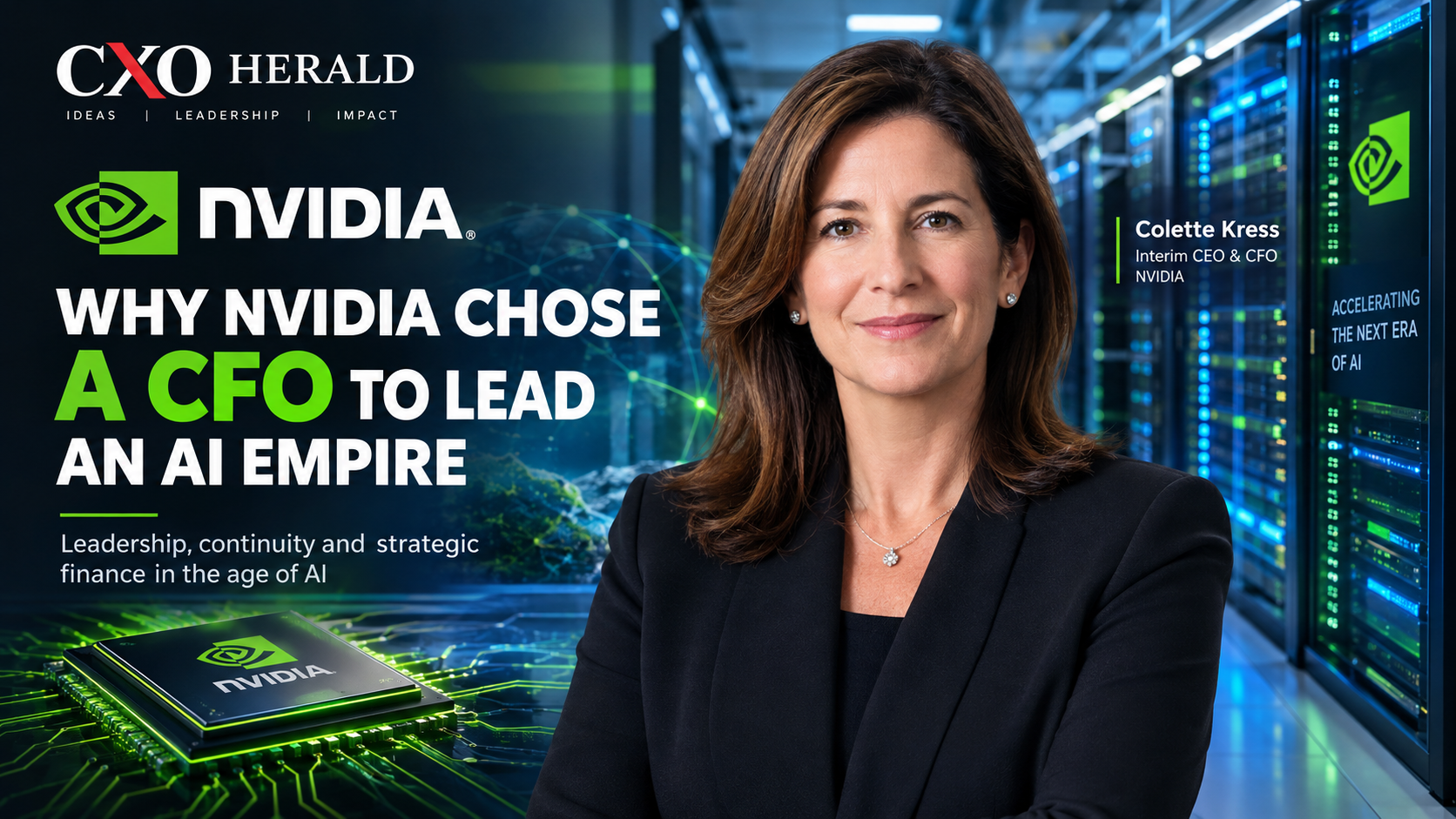
Introduction: When an AI Giant Turns to Its Finance Chief.
In an industry where technological innovation, engineering excellence, product architecture and artificial intelligence capabilities are considered the ultimate sources of competitive advantage, NVIDIA’s decision to appoint its Chief Financial Officer, Colette Kress, as interim Chief Executive Officer is a particularly interesting corporate leadership development.
Why a CFO?
Why not the Chief Technology Officer (CTO), Chief Operating Officer (COO), Chief Information Officer (CIO), or another senior technology executive?
After all, NVIDIA is not a traditional financial services company. It is the company at the centre of the global AI revolution, supplying the computing infrastructure powering generative AI, hyperscale data centres, autonomous systems and increasingly sophisticated AI applications.
Its competitive advantage has been built on semiconductor engineering, GPU architecture, CUDA software, developer ecosystems and a powerful relationship with the world’s largest technology companies.
Yet, at a critical leadership moment, NVIDIA’s board has chosen its finance chief to occupy the CEO’s chair.
On November 12, 2026, NVIDIA officially announced that Jensen Huang had resigned as president and CEO, effective immediately, and that Kress would take over as interim CEO while retaining her CFO responsibilities. The board also announced a search for a permanent successor.
The decision is significant, but its meaning needs to be understood correctly. It does not necessarily suggest that finance is more important than technology at NVIDIA. Rather, it suggests that the board considers financial, institutional and stakeholder continuity particularly important during this immediate transition.
The underlying message: A technology company may be built on innovation, but it must also be governed through financial discipline, strategic judgement and institutional trust.
1. Who Is Colette Kress, and What Does She Bring to NVIDIA?
Colette Kress is not an outsider being brought in to manage an unfamiliar organisation.
She has been NVIDIA’s Executive Vice President and CFO since September 2013. Before joining NVIDIA, she accumulated nearly 25 years of experience in finance and leadership positions across major technology companies.
Her professional background includes:
- Texas Instruments, where she developed experience in the semiconductor industry.
- Microsoft, where she spent 13 years in finance and leadership positions, including CFO of its Server and Tools division.
- Cisco, where she served as a senior finance executive and CFO of its Business Technology and Operations Finance organisation.
- NVIDIA, where she has spent more than 13 years helping manage the company’s financial evolution and extraordinary growth.
This background is particularly relevant.
Kress understands technology-sector economics, semiconductor industry dynamics, capital allocation, enterprise customers, operational expenditure, financial planning and shareholder expectations.
She has also been a familiar face on NVIDIA’s quarterly earnings calls, communicating the company’s financial performance and business outlook to investors.
According to Reuters, NVIDIA’s annual revenue increased from approximately $4.13 billion when she joined to $215.9 billion in fiscal 2026.
That is an extraordinary transformation to have experienced from inside the finance leadership function.
Her value, therefore, is not restricted to accounting, budgeting or financial reporting.
She brings institutional knowledge of how NVIDIA operates as a global technology business.
2. What Does a CFO Bring to the CEO’s Table That Others May Not?
A modern CFO is no longer simply the person responsible for maintaining financial statements, managing taxation and controlling expenditure.
At major technology companies, the CFO increasingly operates as a strategic business partner to the CEO and board.
The position requires an understanding of several interconnected dimensions of corporate performance.
A. Financial stability during leadership uncertainty
Leadership transitions can create uncertainty among investors, institutional shareholders, employees, suppliers, customers and business partners.
In NVIDIA’s case, the departure of its founder and long-serving CEO creates an unusually important continuity challenge.
The company needs reassurance that its financial commitments, business plans, capital allocation priorities and customer relationships will continue without disruption.
A CFO is naturally positioned to communicate that reassurance.
Kress already understands the company’s financial position, revenue streams, investment commitments, cost structures and commercial priorities.
An incoming external CEO would need time to understand these dimensions.
B. Capital allocation and investment discipline
The AI revolution is extraordinarily capital-intensive.
Building AI infrastructure requires substantial investment in semiconductor design, research and development, advanced packaging, software ecosystems, data-centre infrastructure and global supply-chain relationships.
NVIDIA’s leadership must constantly evaluate:
- Where should the company invest its capital?
- Which technologies offer sustainable commercial returns?
- How should research and development priorities be funded?
- How should the company balance growth and profitability?
- How should it manage supply-chain and manufacturing dependencies?
- How should it protect long-term shareholder value?
A CFO with deep institutional knowledge can provide continuity in these decisions.
C. Investor confidence and capital-market communication
NVIDIA is not just a technology innovator; it is also a company whose market valuation and strategic importance attract extraordinary global attention.
Investors want predictable financial communication, credible guidance and confidence that leadership changes will not derail execution.
Kress has already represented NVIDIA in the financial conversations that matter to shareholders.
She understands how investors interpret revenue growth, margins, earnings, forward guidance, capital expenditure and business risks.
This familiarity becomes especially valuable when the market is looking for reassurance.
D. Enterprise and commercial understanding
A technology company does not succeed merely by developing superior technology.
It must convert technological advantages into sustainable business models.
That requires understanding customers, contracts, pricing, product economics, partnerships and commercial opportunities.
NVIDIA’s business involves some of the world’s largest cloud providers, technology companies, AI developers and enterprise customers.
A CFO who has spent more than a decade inside the company develops an understanding of these commercial relationships that goes well beyond traditional financial reporting.
E. Governance and risk management
The CEO’s role is not exclusively about creating products or predicting technological developments.
It also involves protecting the institution.
Corporate governance, regulatory exposure, geopolitical risk, export controls, supply-chain vulnerabilities, shareholder expectations and organisational accountability are all part of the CEO’s responsibilities.
A CFO with boardroom experience and a comprehensive understanding of corporate risk can offer important leadership continuity during a sensitive transition.
3. Why Not the CTO? Isn’t Technology NVIDIA’s Biggest Competitive Advantage?
This is perhaps the most important question.
NVIDIA’s success is fundamentally connected to technology.
Its GPU architecture, CUDA ecosystem, networking capabilities and accelerated computing platforms have helped establish its position in the AI infrastructure market.
A CTO could bring deep technical knowledge, product innovation capabilities and an understanding of future technological opportunities.
But being the best technology strategist does not automatically make someone the best person to manage an immediate corporate leadership transition.
The CTO’s primary responsibility generally centres on technological direction, research, architecture, engineering and innovation.
The CEO must integrate technology with finance, customers, people, governance, markets, partnerships and corporate strategy.
These are different leadership responsibilities.
During an ordinary period of expansion, a technology executive with strong business leadership experience could be an excellent CEO candidate.
During a sudden leadership transition, however, the board may prioritise someone who already understands the entire organisation’s financial and institutional framework.
The important distinction is between leading technological innovation and leading the institution that commercialises it.
NVIDIA needs both.
4. CFO vs CTO vs COO vs CIO vs CMO: Who Is Best Positioned to Become CEO?
There is no universal answer. The right candidate depends on the company’s immediate challenges and long-term strategic priorities.
| Leadership position | Principal strength | Potential CEO advantage | Possible limitation |
|---|---|---|---|
| CFO | Finance, capital allocation, risk and investor relations | Financial stability, governance and stakeholder confidence | May need deeper product and engineering support |
| CTO | Technology, innovation and engineering | Product vision and technological competitiveness | May have less experience with capital markets and enterprise-wide governance |
| COO | Operations, execution and organisational management | Business continuity and execution discipline | May need stronger external strategic and investor-facing leadership |
| CIO | Enterprise technology and digital infrastructure | Technology transformation and systems integration | Usually narrower exposure to the entire commercial business |
| CMO | Brand, customers and market positioning | Market expansion, customer relationships and brand leadership | May need greater experience in financial and operational management |
A CFO may be the most appropriate interim CEO when the immediate priority is stability.
A CTO may be better positioned when the company’s future depends on a major technological transformation.
A COO may be the strongest candidate when operational complexity and execution are the central challenges.
A CMO may be a compelling candidate in a business facing a fundamental customer or market transformation, provided the individual has broader leadership experience.
The lesson is that the CEO position is not a reward for occupying the most prestigious functional role.
It is a responsibility requiring the broadest combination of organisational leadership capabilities.
5. Why NVIDIA’s Decision Makes Sense in the Short Term
There are several reasons why Kress makes sense as an interim CEO.
First: Institutional memory.
She has spent more than a decade inside NVIDIA and understands the company’s evolution, leadership culture, commercial priorities and financial architecture.
Second: Market familiarity.
She is already a recognised financial spokesperson for NVIDIA. Investors do not need to become familiar with an entirely new face during an uncertain period.
Third: Business continuity.
She can work with the existing leadership team without requiring an immediate restructuring of the organisation.
Fourth: Board confidence.
The board’s announcement specifically highlighted her understanding of NVIDIA’s business, customers, operations and financial position.
Fifth: Time for a considered succession decision.
An interim appointment allows the board to assess internal and external candidates without rushing into a permanent appointment.
This is particularly important because replacing a founder who has led a company for more than three decades is not a routine executive recruitment exercise.
6. Does This Mean the CFO Is More Powerful Than the CTO or COO at NVIDIA?
Absolutely not.
This is an important distinction that corporate observers should not overlook.
An interim CEO appointment is not necessarily a declaration of functional superiority.
It is a decision about the company’s immediate leadership requirements.
NVIDIA’s technology strategy cannot be separated from its engineering leadership.
The company’s competitive advantage depends on people who understand chip design, software platforms, systems architecture, networking, AI computing and developer ecosystems.
A CFO cannot independently replace that collective expertise.
Nor should an interim CEO attempt to do so.
The most effective leadership arrangement would involve Kress working closely with NVIDIA’s technology, product, operations and commercial leaders.
The CEO must provide strategic coordination, establish priorities, maintain organisational confidence and ensure that the company continues executing its roadmap.
In other words, the CFO does not have to become the chief technologist.
She must ensure that the chief technologists, engineers and business leaders continue delivering results.
7. The Jensen Huang Factor: NVIDIA’s Biggest Succession Challenge
The most complicated aspect of NVIDIA’s leadership transition is not the appointment of a new CEO.
It is the challenge of replacing Jensen Huang’s extraordinary institutional influence.
Huang co-founded NVIDIA in 1993 and has led the company throughout its transformation from a graphics-chip business into a central infrastructure provider for the AI economy.
His contribution extends beyond executive management.
He has played a defining role in technology vision, product direction, ecosystem development, strategic partnerships and corporate culture.
This creates what corporate governance experts describe as key-person risk.
When a company becomes closely identified with one individual, succession becomes more complicated.
The organisation may have outstanding executives, but the founder’s strategic judgement, external relationships and authority cannot automatically be transferred to another person.
NVIDIA’s board must therefore address two separate challenges:
- Ensuring immediate business continuity.
- Identifying a permanent CEO capable of sustaining the company’s technological and commercial leadership.
Kress can address the first challenge.
Whether she is the best person to address the second is a separate question.
8. Could NVIDIA Eventually Choose a Technology Leader as Its Permanent CEO?
That remains a possibility and deserves serious consideration.
Reuters reporting ahead of the appointment identified senior technology executive Ian Buck as another potential internal candidate.
Buck’s experience with NVIDIA’s accelerated computing and CUDA ecosystem illustrates the importance of technical leadership in any permanent succession decision.
The company may ultimately conclude that its next CEO needs a combination of technological vision, commercial understanding, organisational leadership and global stakeholder management.
Alternatively, it could select an experienced external executive.
The board’s challenge is to identify someone who can preserve NVIDIA’s technological momentum while broadening its leadership beyond the founder.
The most sensible approach may be a strong partnership between the CEO and an empowered technology leadership team.
The AI industry is moving too quickly for a CEO to be the sole source of technological insight.
The future of NVIDIA will depend on its ability to institutionalise innovation rather than make it dependent on a single individual.
9. Five Leadership Lessons for Other Technology Companies
NVIDIA’s decision offers several important lessons for boards, founders and senior executives.
Lesson 1: Develop CFOs as strategic business leaders.
Finance leaders should participate in product strategy, investment decisions, customer economics and long-term business planning, rather than being confined to financial control.
Lesson 2: Build succession plans before a crisis.
A company should never depend entirely on one individual for its strategic direction.
Lesson 3: Recognise that technology excellence and CEO readiness are different capabilities.
A brilliant engineer may become an outstanding CEO, but technical brilliance alone does not guarantee enterprise leadership capability.
Lesson 4: Protect institutional continuity during leadership transitions.
Boards must consider investor confidence, employees, customers, suppliers and business partners when selecting interim leadership.
Lesson 5: Build leadership teams, not individual dependencies.
The most resilient companies distribute strategic knowledge, decision-making authority and accountability across experienced executives.
10. The Bigger Message: The AI Era Needs More Than Technology Leaders
There is a broader lesson for the global technology industry.
The AI revolution is creating companies with extraordinary technological capabilities, but these companies are also becoming increasingly complex financial, commercial and geopolitical institutions.
Their leaders must understand technology, but they must also understand capital markets, global regulation, enterprise customers, strategic partnerships, organisational behaviour and long-term value creation.
The CEO of an AI company cannot simply be the smartest technologist in the room.
Nor can the CEO be only the best financial manager.
The role requires the ability to connect technological possibility with commercial reality.
That is why NVIDIA’s appointment of Colette Kress is an interesting case study in modern corporate leadership.
It demonstrates that, when a company faces an unexpected leadership transition, the board may prioritise the executive who can protect the institution immediately rather than the executive who appears most closely associated with its core technology.
Conclusion: A CFO Can Keep the Ship Steady, But Who Will Define Its Next Destination?
NVIDIA’s decision to appoint Colette Kress as interim CEO should not be interpreted as a victory of finance over technology.
It should be understood as a strategic choice about leadership continuity at an exceptionally sensitive moment.
Kress brings financial credibility, institutional knowledge, technology-sector experience, investor familiarity and an understanding of NVIDIA’s commercial operations.
These are valuable capabilities when a company needs stability.
However, NVIDIA’s longer-term challenge remains much bigger.
The company must preserve the innovation engine that made it a global AI powerhouse while building a leadership structure that does not depend excessively on one individual.
Ultimately, the most successful CEO of an AI company will not necessarily be its best engineer, its best financial executive or its best operations manager.
It will be the person who can bring all these capabilities together.
The future of AI leadership will belong to executives who understand both the language of technology and the economics of turning that technology into enduring business value.
CXO Herald Perspective: NVIDIA’s interim CEO appointment is a reminder that technology creates competitive advantage, but institutional leadership determines whether that advantage can survive generations of change.