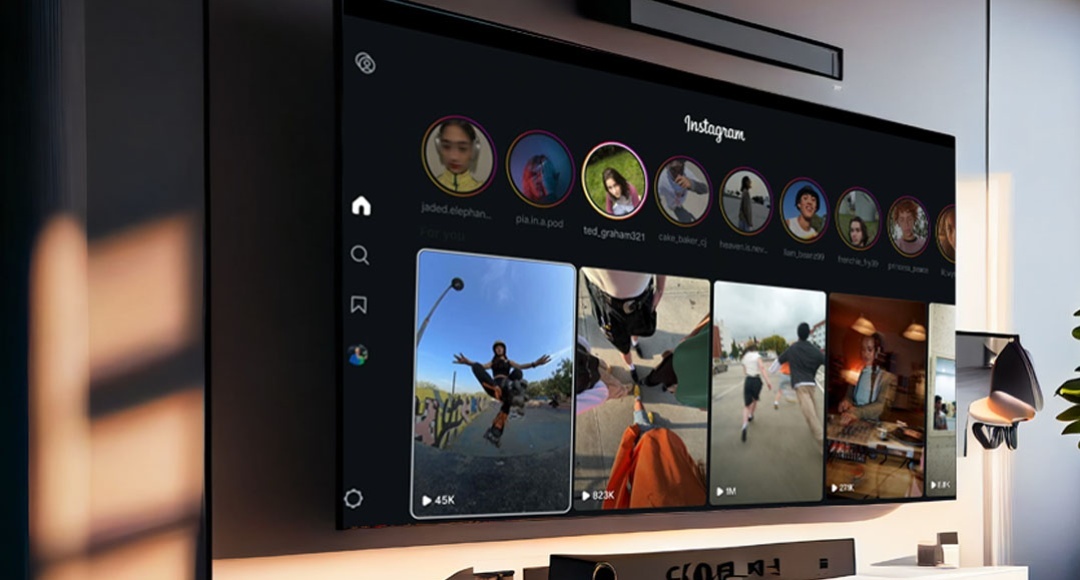
Instagram is expanding its offerings for televisions and is now also available on Samsung Smart TVs in the US. In addition to Reels, Stories, longer videos, and in the future, series and live formats will play a role on the big screen. For Meta, this also raises the question of how the mobile social network can be translated into a shared television experience.
How much potential does social media have for creating a shared experience? Instagram for TV has been available since the end of 2025. Following Amazon Fire TV and Google TV, Samsung Smart TVs are now being added. In the US, devices from the 2020 model year onward are supported. According to Meta, this means Instagram is accessible on a large portion of the connected TVs used there. The application initially focuses on Reels and organizes videos by interests such as sports, comedy, or specific creators.
Meta justifies the move with a changing user experience: Instagram is no longer just used individually on television, but often together with family or friends. Accordingly, the company is testing features designed to facilitate the shared discovery and sharing of videos. These include casting Reels from a smartphone to the television, viewing Stories on the big screen, and a dedicated section for horizontal videos.
From smartphone to shared screen
However, the expansion to television also changes the requirements for Instagram. A large portion of its content was originally developed for mobile, vertical viewing. Meta is therefore testing formats that are more tailored to the characteristics of television. These include longer videos, episodic series, and live content.
Instagram is trying to avoid forcing creators to completely overhaul their production methods. The company explained to Forbes that it’s not about encouraging creators to produce “TV content.” Rather, the goal is to help existing content reach additional audiences. At the same time, Instagram wants to work with creators to determine which formats work best on television.
Competition for television time
Instagram is not entering an uncharted market. YouTube already has a strong presence on televisions, competing not only with social media platforms but also with traditional streaming and media providers. According to Nielsen, in May 2026, a significant portion of television usage was on YouTube , placing the platform ahead of many established media offerings.
TikTok is also trying to bring its content to larger screens . The platform allows users to stream TikTok videos to televisions and is also working with Disney to distribute selected TikTok content via Disney+. This creates competition for the time users spend watching TV instead of on their smartphones.
Another experiment
For Instagram, the TV initiative is therefore more than just an additional app for smart TVs. It opens up another distribution channel for creators and a way for Meta to bring Reels into a usage context that has so far been dominated primarily by YouTube, streaming services, and traditional television broadcasters. At the same time, it remains to be seen whether Instagram’s mobile usage patterns can actually be transferred to shared television viewing. Meta itself continues to describe Instagram for TV as being in an early stage of development and announces further tests.