What Mahatma Gandhi’s Life Still Teaches Marketers, Brands and Economists in the Age of AI?
By CXO Herald Editorial Team
In an age of artificial intelligence, influencer marketing, algorithmic advertising, short-form video and data-driven consumer journeys, it may seem unusual to look to a man who wore khadi, travelled extensively on foot and communicated without television, social media or digital advertising.
Yet Mahatma Gandhi understood something that many modern brands are still trying to master: people do not merely buy products; they buy meaning, identity, trust and belonging.
Gandhi was not a marketer in the conventional commercial sense. But his ability to build a movement, create symbols, understand communities, communicate a simple proposition and convert an idea into mass participation offers remarkable lessons for contemporary marketing.
His economic thinking—particularly Swadeshi, self-reliance, trusteeship, decentralisation, ethical consumption and the welfare of the last person—also provides a useful framework for debates around responsible capitalism, local economies and stakeholder-oriented business.
The Gandhi Heritage Portal identifies Hind Swaraj, Satyagraha in South Africa, The Story of My Experiments with Truth and Constructive Programme among his key texts, providing an extensive primary-source base for understanding his ideas.
The question for today’s CMO, entrepreneur and economist is therefore not whether Gandhi was a modern marketer.
It is:
What can the modern marketer learn from Gandhi?
1. Gandhi understood that a powerful brand needs a powerful purpose
Today’s marketing vocabulary is filled with terms such as purpose-driven branding, brand mission, ESG, stakeholder capitalism and social impact.
Gandhi operated with a much simpler principle: an idea must have a purpose larger than the person promoting it.
His campaigns were not built merely around Gandhi as an individual. They were built around concepts—Swaraj, Swadeshi, Satyagraha, equality and non-violence.
The lesson for brands is profound.
A company can spend millions on advertising, but advertising cannot permanently compensate for the absence of a meaningful reason to exist.
The strongest contemporary brands increasingly articulate:
- What problem do we solve?
- Whom do we serve?
- What do we stand for?
- What change do we want to create?
- Why should people believe us?
Gandhi’s life demonstrates the power of turning an abstract philosophy into a simple, recognisable proposition.
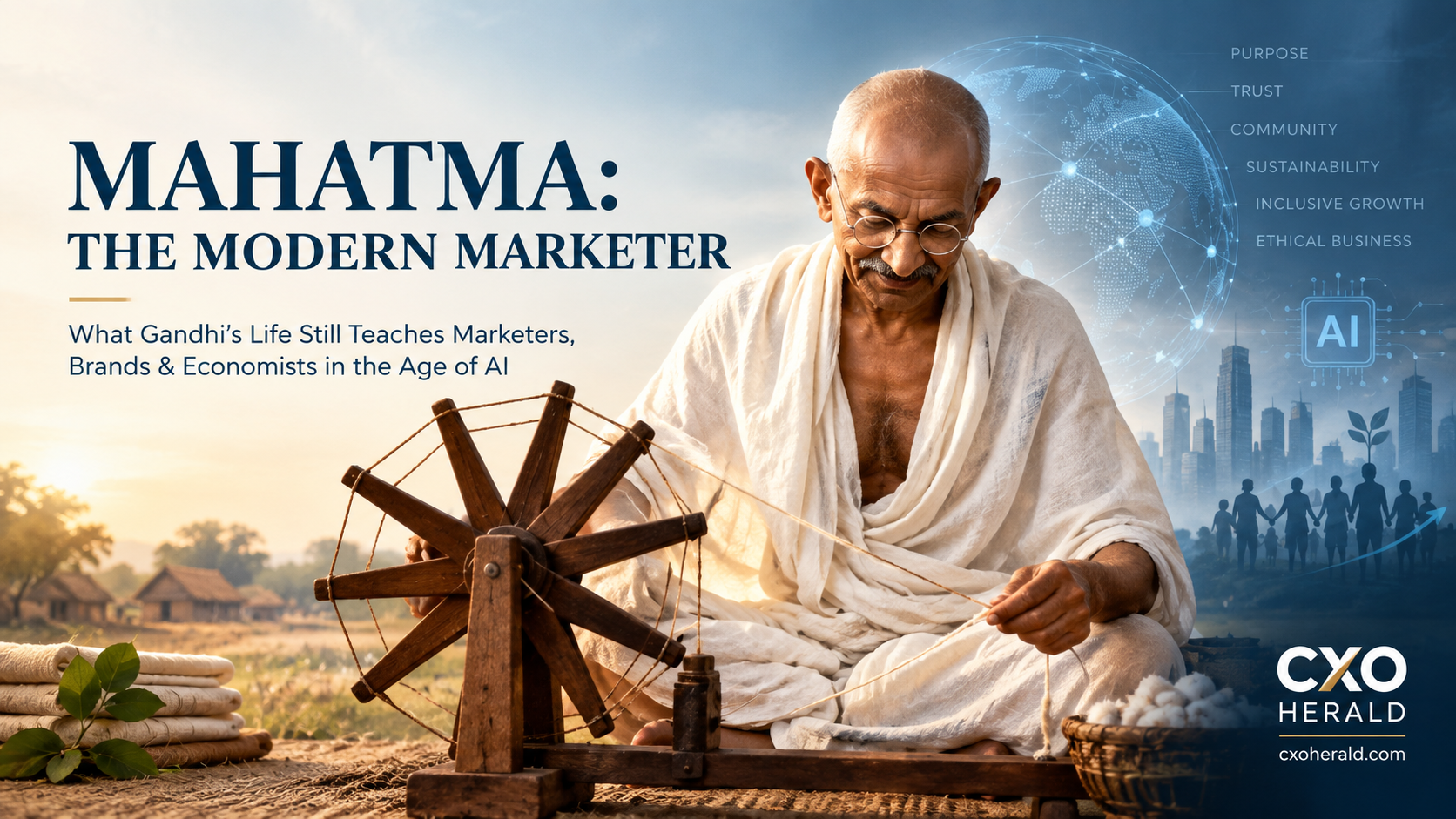
2. The Charkha was perhaps one of history’s most powerful brand symbols
Modern marketing spends enormous resources developing logos, mascots, packaging, visual identities and brand assets.
Gandhi had the charkha.
The spinning wheel was not simply an object. It became a visual representation of self-reliance, Swadeshi, dignity of labour and economic participation. Khadi similarly became more than clothing; it was connected with nationalism, equality and self-reliance.
This offers an important lesson in contemporary brand strategy:
A great brand symbol compresses a complicated philosophy into something people can see, remember and participate in.
Think of how modern consumers recognise brands through colours, sounds, shapes and symbols even before seeing the brand name.
Gandhi understood this decades before the language of brand identity systems became commonplace.
The charkha was effectively a physical interface between ideology and consumer behaviour.
3. Make the customer a participant—not merely a consumer
One of the biggest shifts in modern marketing is the movement from:
Brand → Advertisement → Consumer
towards:
Brand → Community → Participation → Advocacy
Gandhi’s movements were fundamentally participatory.
People did not merely listen to him. They:
- wore khadi,
- spun yarn,
- participated in marches,
- boycotted certain products,
- joined constructive programmes,
- adopted symbols and behaviours associated with the movement.
The Government of India’s Gandhi Smriti and Darshan Samiti describes the Constructive Programme as encompassing areas ranging from khadi and village industries to education, labour, tribal welfare and economic equality.
This is strikingly relevant to today’s community-led marketing.
The modern equivalent could be:
Don’t just sell the product. Build a community around the problem, purpose or identity that the product represents.
4. Simplicity beats complexity
Today’s marketing ecosystem has become technologically sophisticated.
Customer Data Platforms.
Marketing automation.
Generative AI.
Predictive analytics.
Programmatic advertising.
Personalisation engines.
Yet consumers remain human.
Gandhi’s communication frequently reduced complicated political, social and economic ideas into simple actions and memorable symbols.
That principle remains exceptionally relevant.
A marketing message should answer quickly:
Why should I care?
If consumers need three paragraphs, five screens and a technical explanation to understand a brand proposition, the communication architecture may need rethinking.
The modern marketer should therefore ask:
Can our most important idea be understood in one sentence?
5. Authenticity is stronger than manufactured credibility
Gandhi’s personal life was inseparable from his public message.
He did not simply advocate simplicity; his lifestyle reflected it.
He did not merely speak about self-reliance; he promoted khadi and the charkha.
He did not merely discuss mass participation; he physically travelled among communities.
This creates a powerful contemporary lesson.
Consumers increasingly examine whether a company’s behaviour matches its advertising.
A brand that claims sustainability while behaving irresponsibly creates a credibility gap.
A company that talks about employee welfare while ignoring employees creates another.
A company that claims customer obsession but makes customer service deliberately difficult creates yet another.
The modern equivalent of Gandhi’s principle could be expressed as:
Don’t advertise the values you don’t operationalise.
Brand communication should amplify reality—not manufacture it.
6. Swadeshi anticipated today’s local-first economic thinking
Swadeshi is frequently reduced to the idea of buying domestic products.
Gandhi’s conception was broader.
It connected economic behaviour with one’s immediate community and the strengthening of local productive capacity. Contemporary interpretations of Gandhian Swadeshi describe it as an economic philosophy of supporting local industries and serving one’s immediate economic neighbourhood.
In today’s terminology, this intersects with several major economic trends:
- local manufacturing,
- MSME development,
- supply-chain resilience,
- community entrepreneurship,
- circular economies,
- regional brands,
- responsible sourcing,
- distributed production.
The global economy has demonstrated the vulnerability of excessively concentrated supply chains.
Consequently, local resilience and global integration are no longer necessarily opposites.
A modern interpretation of Swadeshi could therefore be:
Build local capability while participating intelligently in the global economy.
7. Gandhi understood the economics of identity
Why did khadi become powerful?
Because Gandhi did not sell it merely as fabric.
He connected a product with an identity.
Wearing khadi could communicate:
I support self-reliance.
I participate in a national movement.
I identify with a larger cause.
That is sophisticated consumer psychology.
Modern brands similarly associate products with identities:
- sustainable consumer,
- fitness enthusiast,
- technology innovator,
- conscious traveller,
- premium lifestyle consumer,
- socially responsible citizen.
The product becomes a symbolic extension of the consumer’s identity.
This is why marketers should study not only demographics but also:
beliefs + aspirations + identity + community.
8. Trust is the ultimate marketing currency
Digital marketing has made distribution easier.
It has not made trust easier.
Consumers today face:
- misinformation,
- deepfakes,
- fake reviews,
- influencer controversies,
- hidden advertising,
- data privacy concerns,
- AI-generated content.
As content becomes easier to manufacture, credibility becomes more valuable.
Gandhi’s public philosophy placed extraordinary emphasis on truth.
His concept of Satyagraha was not simply a communication technique. It was rooted in truth and non-violent action.
For modern companies, the commercial translation is straightforward:
Trust cannot be optimised only through media buying.
It must be built through consistent behaviour.
A trusted brand can survive a communication mistake.
A brand that lacks trust can struggle even with excellent advertising.
9. “Last-mile” marketing begins with the last person
Gandhian thinking repeatedly brought attention to the poorest and weakest sections of society.
His well-known “talisman” asked decision-makers to consider whether a contemplated action would benefit the poorest and weakest person.
This has an important modern business implication.
Companies frequently discuss:
Total Addressable Market (TAM).
Gandhi would have encouraged us to think about something else:
Total Addressable Human Need.
The difference matters.
Financial technology, healthcare, education, insurance and digital public infrastructure can generate enormous economic value when designed for people traditionally excluded from formal systems.
This is where inclusive innovation and Gandhian thinking intersect.
10. Trusteeship and the rise of stakeholder capitalism
Gandhi’s concept of trusteeship proposed that wealth should be held with a responsibility towards society rather than treated exclusively as private entitlement.
His economic philosophy therefore raises questions that remain central to contemporary capitalism:
- What responsibilities accompany ownership?
- What should businesses owe employees?
- What responsibility does capital have toward communities?
- How should economic growth be distributed?
- Can profitability coexist with social responsibility?
Gandhian trusteeship is not identical to modern ESG or stakeholder capitalism, and it should not be presented as their direct historical equivalent.
But there is a conceptual intersection: economic activity carries responsibilities beyond immediate financial return.
Contemporary discussions of Gandhian economics continue to examine trusteeship, non-possession, labour and economic equality.
11. Gandhi and the economics of “enough”
Modern marketing is frequently built around stimulating demand.
More features.
More upgrades.
More consumption.
More convenience.
Gandhian economics raises a counter-question:
How much consumption actually improves human welfare?
His emphasis on simplicity, restraint and non-possession challenges the assumption that increased consumption automatically equals increased wellbeing.
This debate is increasingly relevant to:
- sustainable consumption,
- circular economy,
- minimalism,
- responsible production,
- climate economics,
- product longevity,
- repair and reuse.
The challenge for modern business is not necessarily to eliminate consumption.
It is to create greater value with fewer unnecessary resources.
12. The Gandhi lesson for AI marketing
Artificial intelligence is transforming marketing.
AI can generate:
- advertisements,
- images,
- videos,
- sales copy,
- customer segmentation,
- recommendations,
- campaign strategies.
But AI also creates a new problem:
content abundance.
When everybody can generate thousands of pieces of content, content itself becomes less scarce.
Trust becomes scarce.
Attention becomes scarce.
Authenticity becomes scarce.
Human connection becomes scarce.
This makes Gandhi’s lessons unexpectedly relevant.
The future marketer will need to combine:
AI efficiency + human authenticity
rather than assuming technology can replace credibility.
13. From mass media to mass mobilisation
Gandhi achieved extraordinary reach without television, radio advertising, search engines or social media.
His communication architecture relied heavily on:
message + symbol + participation + repetition + personal contact + community networks.
That model has an interesting digital equivalent.
A contemporary movement or brand can use:
Content → Community → Creators → Participation → Advocacy → Network effects
The platforms have changed.
The psychology has not.
14. Gandhi’s economic lesson for Indian startups
For India’s startup ecosystem, Gandhi’s ideas raise several strategic questions.
Can a startup create employment rather than merely optimise transactions?
Can technology empower smaller businesses?
Can local producers participate in digital commerce?
Can capital generate both financial and social returns?
Can innovation reach Tier-2, Tier-3 and rural markets?
Can growth be decentralised?
These questions are especially important as India builds a digital economy in which UPI, ONDC, Aadhaar-enabled infrastructure, digital public infrastructure and AI increasingly connect consumers, entrepreneurs and institutions.
The modern interpretation of Gandhian economics need not reject technology.
It can ask:
Who benefits from the technology, who participates in its value creation, and who may be left behind?
15. Five Gandhian principles every modern CMO can use
| Gandhian Principle | Modern Marketing Interpretation |
|---|---|
| Truth | Authentic communication and transparent claims |
| Swadeshi | Local relevance, community and resilient supply chains |
| Charkha | Powerful visual brand symbolism |
| Satyagraha | Purpose-led, consistent action |
| Trusteeship | Stakeholder responsibility and responsible capitalism |
These are not one-to-one historical equivalents. They are modern strategic interpretations of principles associated with Gandhi.
The Modern Marketing Mantra: Less Noise, More Meaning
Perhaps the most important lesson from Gandhi is not a marketing technique.
It is a philosophy of communication.
In an environment where brands compete for milliseconds of attention, the temptation is to become louder.
Gandhi’s approach suggests another possibility:
Become clearer.
In a world flooded with content:
Become more credible.
In a world of transactional relationships:
Build community.
In a world obsessed with scale:
Remember the individual.
In a world increasingly powered by artificial intelligence:
Protect the human element.
And in an economy where businesses are increasingly influential social institutions:
Treat economic power as responsibility as well as opportunity.
Conclusion: The Man Who Marketed an Idea
Mahatma Gandhi never ran a conventional marketing department.
He did something arguably more difficult.
He transformed ideas into identities, identities into behaviour, behaviour into participation and participation into a mass movement.
The charkha became a symbol.
Khadi became a statement.
Swadeshi became an economic and social proposition.
Satyagraha became a method of collective action.
That is why Gandhi remains relevant to the modern marketer—not because his methods can simply be copied, but because his life demonstrates a timeless principle:
People remember brands that give them something to believe in, participate in and become part of.
The technology of marketing will continue to change.
Search will evolve.
AI will evolve.
Social platforms will evolve.
Consumer behaviour will evolve.
But trust, meaning, identity, community and human dignity will remain powerful forces in both markets and societies.
Perhaps that is the real lesson of Mahatma, the Modern Marketer:
The most powerful marketing does not merely persuade people to buy something. It gives people a reason to believe that their participation matters.