
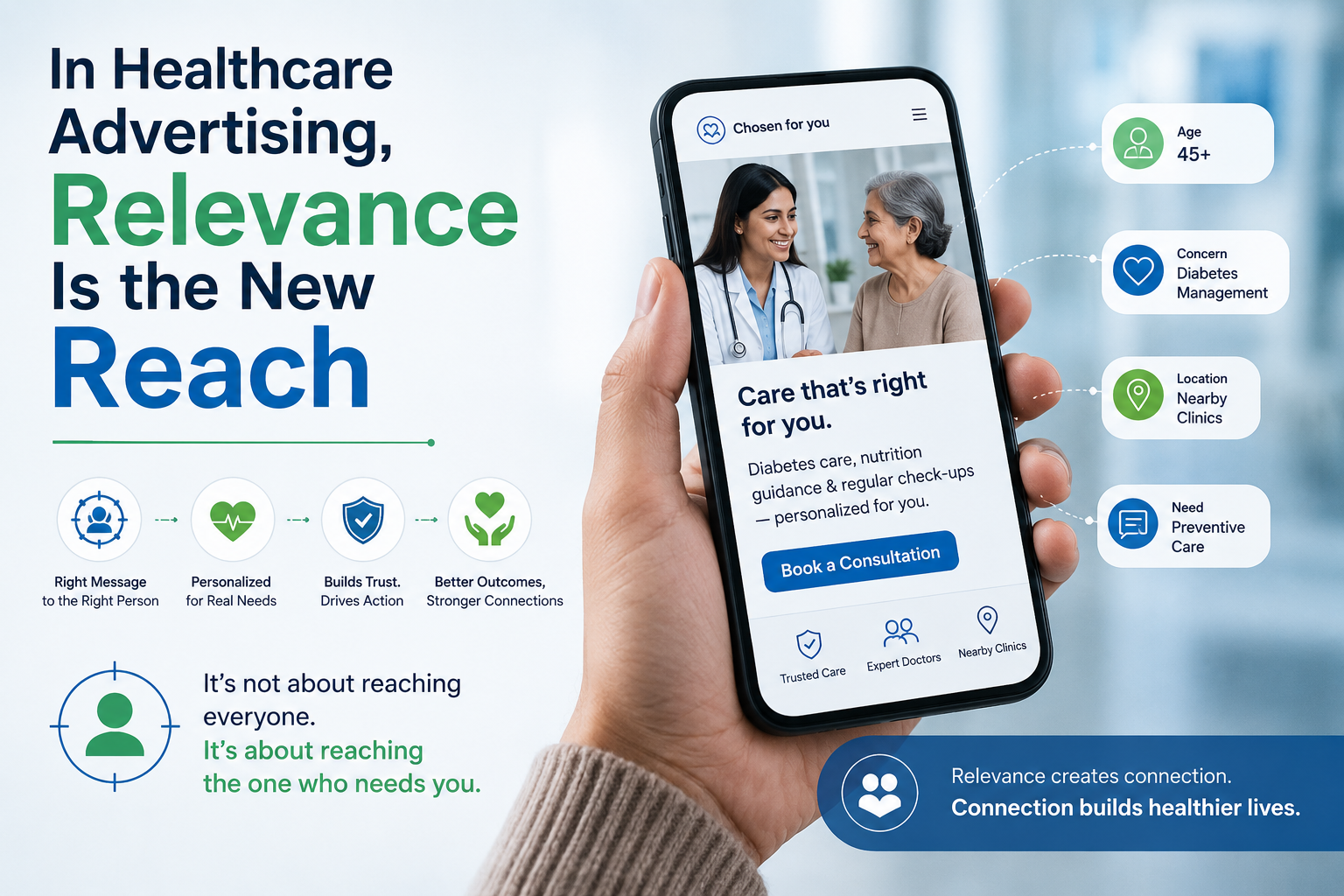
For decades, healthcare advertising was built around a familiar equation: reach as many people as possible, repeat the message often enough, and hope that the right patient—or caregiver—sees it at the right moment.
That model is changing.
Healthcare consumers are becoming more informed, more digitally connected and more selective about the information they trust. They search for symptoms before seeing a physician, compare hospitals and specialists online, investigate treatment options, review insurance coverage and increasingly expect healthcare organizations to communicate with them as individuals rather than anonymous members of a demographic segment.
The result is a fundamental shift in healthcare advertising:
Reach gets attention. Relevance earns engagement.
Recent research from McKinsey illustrates the opportunity. In its 2024 health-media research, up to 77% of surveyed consumers said sponsored healthcare and wellness content was helpful or neutral. At the same time, approximately 60% said they would feel violated or angry if their clinical data were used to target health and wellness advertising without their consent. (McKinsey & Company)
That tension—between personalization and privacy—will define the next era of healthcare advertising.
From Mass Marketing to Moments That Matter
Traditional advertising asks: Who can we reach?
Modern healthcare advertising increasingly needs to ask: What does this person need right now?
A patient researching breast cancer has very different information needs from someone comparing primary-care physicians. A newly diagnosed patient may need educational information about treatment pathways, while a caregiver may be searching for transportation, financial assistance or home-care resources.
The advertising opportunity is therefore not simply demographic.
It is contextual.
Consider a healthcare journey:
Awareness → Research → Diagnosis → Treatment Decision → Access → Treatment → Recovery → Long-term Management
Each stage creates a different information need. Advertising that recognizes the stage can become useful rather than intrusive.
For example, someone reading an authoritative article about cancer screening may respond to information about screening services. Someone researching treatment options may value educational material about multidisciplinary care. A person already receiving treatment may be more interested in financial support, transportation, nutrition or rehabilitation services.
The most effective healthcare advertising will increasingly be designed around these moments that matter.
McKinsey’s research found that consumers were particularly receptive to healthcare advertising when they were learning about health conditions and managing their health at home. It also found that consumers were more likely to engage with ads related to their healthcare journey than with unrelated advertising. (McKinsey & Company)
That is a powerful signal for healthcare marketers: context can be more valuable than volume.
The Patient Journey Is Becoming the Media Strategy
Healthcare organizations traditionally treated advertising, patient engagement, clinical communication and customer experience as separate functions.
Digital healthcare is breaking down those boundaries.
A hospital website is no longer simply a digital brochure. A payer portal is no longer merely a place to check benefits. A patient app is no longer only an appointment tool.
These platforms can become part of a connected patient journey.
Imagine a cancer patient moving through the system.
At the beginning, the patient may search for information about symptoms or screening. After diagnosis, the information need becomes more specific: specialists, treatment options, clinical trials, second opinions and expected costs. Once treatment begins, the focus may shift toward medication management, appointments, transportation, nutrition, financial support and recovery.
Advertising and sponsored content can potentially support those needs—but only if the message is appropriate to the moment.
This creates a new model:
Instead of advertising around the patient journey, advertise within the patient journey.
That distinction matters.
Hospitals Have an Emerging Advantage
Health systems possess something most consumer brands struggle to obtain: trusted context.
A hospital or health system already has an established relationship with patients and a large ecosystem of clinically relevant content. It knows the questions patients ask, the services they need and the stages through which they move.
McKinsey has described this emerging opportunity as “health media”: healthcare organizations can use medically validated and contextually relevant content—including advertising—to engage, educate and support consumers while creating a new revenue opportunity. (McKinsey & Company)
This does not mean turning a hospital website into an advertising marketplace filled with unrelated banners.
Quite the opposite.
The opportunity is to create an environment where commercial messages are useful, credible and clearly separated from clinical advice.
For example, relevant advertising could include information about transportation services, home healthcare, wellness programs, financial services, medical devices or other healthcare-related offerings—provided that the content, commercial relationship and privacy practices are transparent and appropriate.
The principle should be simple:
If an advertisement does not improve the consumer’s experience, it probably does not belong in the patient journey.
Insurance Companies Can Become Part of the Same Journey
Payers have an equally important role.
For many patients, healthcare decisions are inseparable from questions about affordability and access.
Which hospital is in network?
What will the procedure cost?
Does the plan cover a particular specialist?
Is prior authorization required?
Are transportation or home-care services available?
What financial support is available?
These are not peripheral questions. They influence where, when and how people receive care.
A smarter advertising ecosystem could therefore connect clinical relevance with financial relevance.
Imagine a patient researching cancer treatment. Instead of receiving generic advertisements, the patient could encounter clearly labeled information about covered services, care-navigation resources, transportation benefits, financial counseling or other relevant services.
The goal is not to use sensitive information to push commercial messages.
The goal is to reduce friction.
That distinction will become increasingly important as healthcare advertising becomes more sophisticated.
Personalization Without Crossing the Privacy Line
Healthcare has one advantage over many other industries: consumers understand that their data is sensitive.
That creates a very different standard for personalization.
In the United States, HIPAA places significant restrictions on the use and disclosure of protected health information for marketing. HHS states that, with limited exceptions, authorization is required when PHI is used or disclosed for marketing purposes. (HHS.gov)
Healthcare organizations also need to consider broader consumer-protection obligations. HHS notes that the FTC Act can apply to companies handling consumer health information and that businesses must not create deceptive or misleading impressions about how health data is collected, used or shared. (HHS.gov)
This makes the future of healthcare personalization fundamentally different from retail advertising.
A retailer might say:
“You bought running shoes, so here are more running products.”
Healthcare requires a much more careful question:
“Is this communication appropriate, expected, transparent and permitted?”
The safest path is often to prioritize contextual relevance over invasive individual-level targeting.
For example, an advertisement appearing alongside an article about managing diabetes may be contextually relevant without revealing that the advertiser knows the visitor has diabetes.
That distinction can preserve usefulness while reducing privacy risk.
First-Party Relationships Will Become More Valuable
As privacy expectations increase and the digital advertising ecosystem becomes more restricted, healthcare organizations will increasingly value their direct relationships with consumers.
Patient portals, authenticated apps, newsletters, appointment platforms, health libraries and digital front doors can provide opportunities for consent-based engagement.
But first-party data should not be viewed simply as an advertising asset.
It is fundamentally a trust asset.
Organizations that clearly explain what data they collect, why they collect it and how it is used will be better positioned to build sustainable digital relationships.
The winners will not necessarily be the organizations with the largest databases.
They will be the organizations that consumers trust enough to engage with.
AI Will Make Relevance More Dynamic
Artificial intelligence adds another dimension to this transformation.
AI can help healthcare marketers analyze content performance, understand common information needs, identify gaps in the patient experience and adapt messages across channels.
But the real opportunity is not simply automated ad creation.
It is dynamic relevance.
Instead of developing one campaign for an entire patient population, marketers can increasingly create content frameworks that adapt to:
- The patient’s stage in the healthcare journey
- The type of information being consumed
- The channel being used
- The patient’s expressed preferences
- Geographic or service availability
- Accessibility requirements
- Consent and privacy settings
- The organization’s clinical and commercial boundaries
AI can help scale this complexity, but governance must scale with it.
A healthcare organization should never assume that because an algorithm can infer something about an individual, it should use that inference for advertising.
The New Measurement Model: Beyond Impressions
If relevance becomes the strategic objective, healthcare marketers will also need to rethink measurement.
Reach and impressions will remain useful, but they cannot tell the entire story.
A more meaningful measurement framework could include:
Engagement: Did the consumer interact with the content?
Intent: Did the interaction indicate a genuine healthcare need?
Action: Did the consumer schedule, inquire, enroll or access a relevant service?
Experience: Did the communication make the healthcare journey easier?
Trust: Did the interaction strengthen or weaken confidence in the organization?
Outcomes: Where measurable and appropriate, did the intervention contribute to better adherence, access, continuity or other meaningful outcomes?
This is a move from media metrics to journey metrics.
The question changes from “How many people saw the advertisement?” to “Did the communication help the right person take the right next step?”
That is a much more valuable question.
What Healthcare Advertisers Should Do Next
Healthcare organizations, insurers, pharmaceutical companies and health-tech businesses can begin preparing for the relevance era by focusing on five principles.
1. Map the journey before buying the media
Identify the questions consumers have at each stage of care. Build advertising and content around those needs rather than starting with channels.
2. Make context the first layer of personalization
Before using individual-level information, ask whether the same value can be delivered through contextual targeting.
3. Put consent and transparency at the center
Privacy should not be treated as a compliance paragraph hidden at the bottom of a webpage. It should be part of the user experience.
4. Connect advertising with useful action
An advertisement should lead somewhere meaningful: education, scheduling, navigation, financial assistance, support or another appropriate next step.
5. Measure value, not just visibility
The future KPI is not simply reach. It is relevant reach that produces useful engagement without compromising trust.
The Future Belongs to Helpful Advertising
Healthcare advertising is entering a more sophisticated phase.
The industry no longer has to choose between mass reach and personalized engagement. It can build systems that deliver broad awareness while making individual experiences more relevant—provided that personalization is grounded in consent, context and trust.
The most successful healthcare brands of the next decade may therefore be the ones that stop thinking of advertising as an interruption.
Instead, they will treat it as another layer of the patient experience.
A patient searching for answers does not necessarily want another advertisement.
They want help.
A caregiver navigating an unfamiliar healthcare system does not necessarily want another brand message.
They want direction.
A patient worried about the cost of treatment does not necessarily want another promotion.
They want clarity.
When advertising can provide something genuinely useful at precisely the moment it is needed, the distinction between marketing and service begins to disappear.
That is why the next competitive advantage in healthcare advertising will not simply be who can reach the most people.
It will be who can be most relevant—without sacrificing privacy, credibility or trust.
In healthcare, relevance is no longer the opposite of reach. It is what makes reach valuable.