
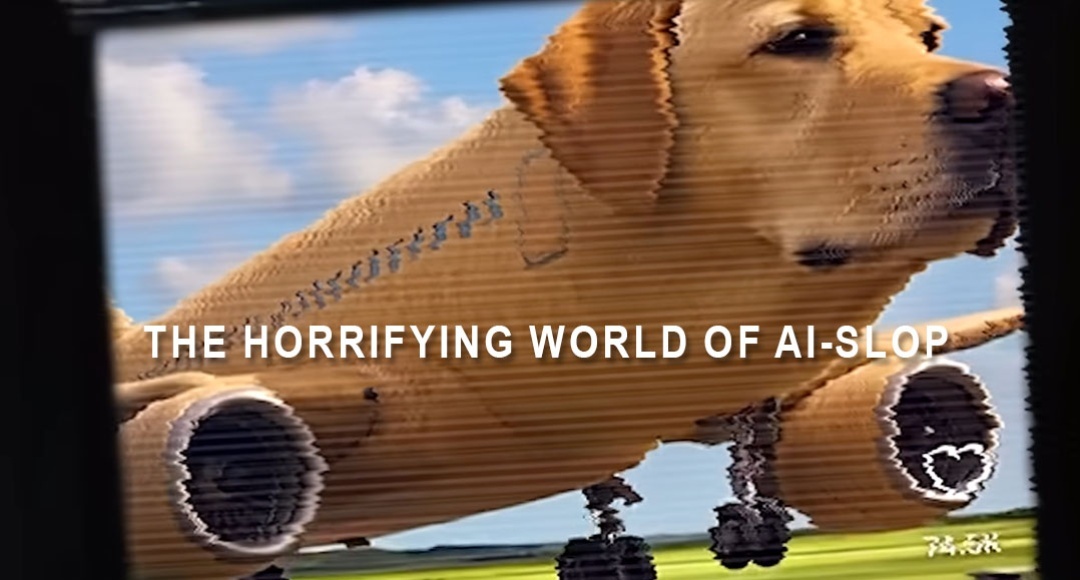
The spirits we summoned: Initially, all social media platforms installed AI tools for their creators, aiming to make them more creative and, above all, more efficient. Now, YouTube, X, and Facebook are massively backtracking. All three companies sense a threat to their business models and are implementing tools and tactics to avoid AI. Not always successfully. X even had to block its own AI, Grok, because spammers were using it to flood its accounts. Are the platforms’ measures sufficient to win the race against a global armada of AI spammers?
It seems like a coincidence, but it isn’t. On a single day, three company announcements from major social media platforms landed on our desks. All three spoke of a significant intensification of their respective fight against AI slop on their own platforms. This is indeed no easy task. The fundamental question isn’t what was created with AI and what wasn’t.
The real question is what constitutes AI-generated content and what doesn’t. AI-generated subtitles for how-to videos or translations into foreign languages are relatively uncontroversial. But what about AI-generated illustrations, still images transformed into videos, or neatly organized lists instead of cumbersome paragraphs? YouTube, X, Facebook, and also Instagram, TikTok, LinkedIn, and Snap face the same question as the editorial teams at “Der Spiegel” or “Stern”: How far can an author go with AI? With the slight difference that there is, of course, also “cool” AI content that generates a decidedly positive response from users of these social media platforms.
X blocks AI accounts
Nikita Bier, Head of Product at X, writes on the platform: “ We have identified 42,000 accounts that automated responses using chatbots and removed them from the platform.”
X has publicly documented its fight against AI-powered spam bots for the first time, almost in real time. Over a 24-hour period, the company continuously published updates on its platform regarding new attack patterns and countermeasures. The posts demonstrate how quickly automated spam campaigns change: as soon as X detects and blocks a pattern, the operators adapt their bots and try new approaches. According to the company, the public documentation aims to create greater transparency and illustrate that combating bot spam is an ongoing race. X emphasizes that the team is constantly developing and updating new detection methods. “This isn’t a one-off problem, but a permanent cat-and-mouse game,” a blog post states.
Two aspects of this action are particularly noteworthy. Nikita Bier wrote that they have now also had to block the automated use of their in-house AI. “The spammers have started using Grok – X’s AI product – to generate their automated replies.”
Secondly, a theme has clearly been identified that dominates the current content battle. “For the sake of transparency, it should be said: the majority of them were distributing low-quality ‘thought leadership’ content on artificial intelligence via spam.” So, be careful with your next AI-related post on X.
YouTube halts AI monetization
The video platform YouTube is also intensifying its fight against so-called “AI slop”—mass-produced, repetitive videos with little content—and intends to significantly restrict their monetization. Content deemed inauthentic will no longer receive advertising revenue. This primarily affects videos that are produced in large numbers with minimal effort and offer little added value.
The new measures were announced on July 27, 2026. YouTube justifies the move by stating that it is necessary to protect the quality of the platform and promote high-quality content. However, creators are criticizing the move, fearing that the automatic detection system is faulty and will incorrectly classify legitimate content as AI garbage. They warn of unjustified revenue losses. YouTube counters that the guidelines are specifically aimed at abusive, mass-produced content and not at the responsible use of AI as a tool for creative productions.
The comments under the cited video contain many critical voices. While there is general agreement with the rules, YouTube’s recognition system is criticized. The automatic detection of such content is described as “extremely flawed,” with authentic content being falsely labeled as repetitive or mass-produced, or with comments like “YouTube is well on its way to completely alienating users and ending up like Myspace.”
TikTok focuses on creator training
TikTok is also significantly expanding its measures for the safe and transparent use of AI. The company is broadening its media literacy offerings, testing new systems for detecting AI spam, and joining the C2PA Steering Committee to promote industry-wide standards for labeling AI-generated content. Together with NAMLE ( National Association for Media Literacy Education ) deepfake expert Henry Ajder, a guide for the responsible use of AI is being developed, complemented by a new in-app hub.
Since the launch of its education program in November 2025, content from partner organizations has been viewed more than 200 million times. TikTok invested over four million US dollars in the program, according to the company. In its fight against AI spam, the platform reported deleting more than 86 million fake accounts in the first quarter of 2026 alone. Furthermore, using content credentials, creator labels, and invisible watermarks, over 3 billion videos have already been identified as AI-generated.
Meta is once again focusing on authenticity.
Meta is introducing Facebook Verified , a free verification badge that confirms a real person is behind a Facebook profile. Users must record a short selfie video, which is then compared to their existing profile pictures. According to Meta, the verification process takes only a few minutes. The badge is available to Facebook users aged 18 and over, provided they adhere to the community standards and do not exhibit suspicious or inauthentic behavior. Initially, the checkmark will appear in Marketplace, Dating, groups, and on profiles; later, it will also appear on posts in the feed.
The rollout will be phased in in select markets and subsequently rolled out globally. Meta emphasizes that the badge is not an endorsement or guarantee of trust for a user, but merely confirms that “a real person is behind the profile.” The company is responding to the increasing prevalence of AI-generated fake profiles and fraudulent activities on social networks.
However, the badge cannot detect AI-generated content created and distributed by real, verified users. For that, the YouTube tool would be needed. But that tool is reportedly flawed. Furthermore, the question arises whether the platforms even share the same definition of AI slop. They are certainly not in agreement when it comes to free speech.