
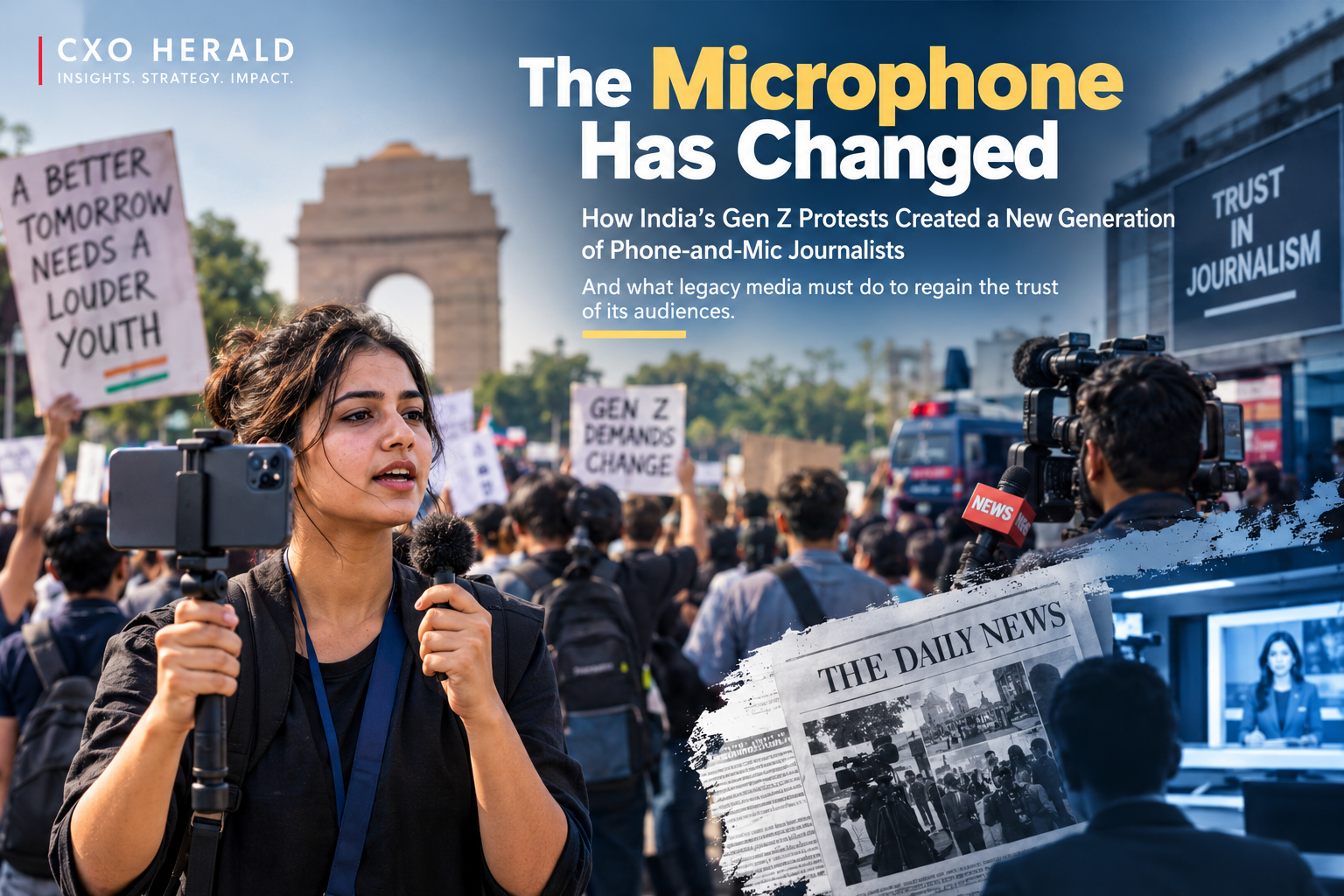
How India’s Gen Z Protests Created a New Generation of Phone-and-Mic Journalists — and What Legacy Media Must Do to Win Back Trust?
From the TV newsroom to the smartphone street corner, India’s 2026 youth protests revealed a fundamental transformation in how journalism is produced, distributed and trusted.
By CXO Herald Editorial
There was a time in Indian journalism when the microphone itself represented authority.
A television camera, a branded microphone, an OB van and a reporter standing outside Parliament, a court or a protest site communicated something important: this is a journalist; this is the news.
In the summer of 2026, that symbolism changed.
At Delhi’s Jantar Mantar, young protesters increasingly viewed the branded television microphone not as a badge of journalism but as a symbol of an establishment they believed had failed to reflect their concerns. Some mainstream television reporters were heckled and, in some cases, physically attacked. At the same time, independent reporters and young digital journalists using smartphones, monopods and small collar microphones were able to move through the crowds and build audiences online.
The contrast was striking.
One generation saw journalism as an institution.
Another increasingly saw journalism as an individual with a phone, a microphone, a point of view and — crucially — a direct relationship with an audience.
The Reuters Institute for the Study of Journalism documented the phenomenon during the 2026 protests, noting that a Gen Z journalist covering the demonstrations used a phone, monopod and small microphone to report from the ground. The same report observed that traditional television microphones themselves had become associated in protesters’ minds with establishment media.
That does not mean that every person holding a smartphone became a journalist.
Nor does it mean that every legacy media organisation lost credibility.
But something important did happen.
The cost of entering journalism collapsed.
And with it came a new question for India’s established media companies:
If anybody can now capture an event, interview a witness, livestream a protest and build an audience, what exactly makes a professional news organisation indispensable?
The answer cannot simply be a bigger studio, a famous anchor or a larger camera.
It has to be trust, verification, context, independence and accountability.
The “phone-and-mic” journalist is not a gimmick. It is a structural change.
The most important lesson from India’s Gen Z protests is not that smartphones are replacing newsrooms.
It is that newsrooms no longer control the first layer of reality.
For decades, professional media organisations controlled several scarce assets:
- cameras;
- distribution networks;
- printing presses;
- broadcast spectrum;
- satellite infrastructure;
- professional editing systems;
- access to public officials;
- large reporting teams;
- audience reach.
The smartphone dismantled much of that scarcity.
Today, a 22-year-old with a ₹20,000 smartphone, a ₹1,500 microphone and an Instagram or YouTube account can potentially reach more people than a local newspaper reporter working for a large media house.
The Reuters Institute’s 2026 India report found that around 58% of surveyed respondents relied on YouTube for news, while television remained an important source, with 44% reporting TV use for news. The report also notes that younger Indians increasingly encounter news through video-based platforms and creators.
The figures come with an important methodological warning: the India survey is primarily of English-speaking online news users and is not nationally representative. But the direction is unmistakable.
The distribution architecture has changed.
Journalism has moved from “institution first” to “person first.”
A newspaper once said:
“Trust us because we are The Newspaper.”
A television channel said:
“Trust us because we are The Channel.”
The digital creator increasingly says:
“Trust me because you can see me, hear me and follow me every day.”
That is a fundamentally different relationship.
The journalist becomes the brand.
The audience becomes a community.
The reporting process becomes visible.
And the journalist can receive immediate feedback from viewers.
This creates enormous opportunities — but also enormous risks.
The new reporter has a phone. The old reporter has something more valuable.
A smartphone can capture reality.
It cannot automatically establish reality.
That distinction is at the heart of journalism’s future.
A protester can film a police charge.
A police officer can film the protesters.
A bystander can film both.
A creator can upload a 30-second clip.
An AI system can create a synthetic version of the same event.
A partisan account can add a misleading caption.
A television channel can broadcast it without adequate verification.
Within minutes, millions of people may have seen something that nobody has properly established.
This is where professional journalism should become more valuable, not less.
The core competitive advantage of journalism should move from capture to verification.
From:
“We have the video.”
to:
“We have established what happened, when it happened, where it happened, who was involved, what remains uncertain and what the evidence actually shows.”
That is a much harder product to manufacture.
It is also a much more valuable one.
Bill Kovach and Tom Rosenstiel’s foundational formulation remains relevant: “Journalism’s first loyalty is to citizens.” Their work also identifies verification as central to the craft.
In an environment of infinite content, verification becomes scarce.
And scarcity creates value.
The 2026 protests exposed a deeper trust problem
The hostility toward some mainstream journalists during the protests should not be interpreted as a justification for attacking reporters.
It isn’t.
The Editors Guild of India explicitly condemned violence against journalists covering the protests while simultaneously warning that flawed and biased reporting can damage journalism’s credibility.
Those two principles can coexist:
Journalists must be protected.
And:
Journalism must be accountable.
The distinction is essential.
A reporter cannot be personally responsible for every editorial decision made by an owner, editor, anchor or network.
Indeed, one of the more revealing observations from the protest coverage was made by journalist Priyanshi Sharma, who argued that ordinary reporters were often being blamed for decisions made higher up in the editorial hierarchy.
That raises an important question for media executives:
When audiences distrust a media organisation, who exactly are they distrusting?
The reporter?
The anchor?
The editor?
The owner?
The business model?
The political positioning?
The advertising dependency?
The editorial culture?
The answer may be all of the above — but not necessarily in equal measure.
The Reuters Institute’s research on trust makes the same broader point: there is no single trust problem and therefore no single trust solution. Different communities distrust news for different reasons.
That should fundamentally change how media organisations approach the problem.
India’s trust problem is not simply a “Gen Z problem”
It would be a mistake for legacy media executives to conclude:
“Young people don’t trust us because they prefer Instagram.”
The problem is deeper.
Digital platforms have changed how people encounter news, but they have also changed what audiences expect from journalism.
They expect:
- immediacy;
- accessibility;
- personality;
- transparency;
- direct interaction;
- visual evidence;
- local relevance;
- explanations;
- responsiveness;
- corrections;
- authenticity.
And they increasingly expect journalists to explain how they know something.
The Reuters Institute’s 2026 India data put overall trust in news at 39%, down four percentage points from the previous year. At the same time, the report notes that trust in some established print publishers and public broadcasters remains relatively high.
That is an important nuance.
The evidence does not say that Indians have abandoned legacy media.
It says the ecosystem is fragmenting.
Print, television, websites, YouTube creators, Instagram accounts, WhatsApp communities, podcasts and independent digital publishers now coexist.
The future is therefore unlikely to be:
Legacy media versus creators.
It is more likely to be:
Legacy institutions + professional reporters + creators + communities + technology.
The organisations that understand that ecosystem will have an advantage over those that treat it as a zero-sum battle.
The biggest mistake legacy media can make: copying creators
The obvious response is to hire young presenters, put reporters on Instagram and launch a YouTube channel.
That is necessary.
It is not sufficient.
A legacy newsroom that simply takes its television bulletin and cuts it into vertical videos has misunderstood the transformation.
Young audiences are not merely asking for shorter news.
They are asking for different journalism.
Consider the difference.
Old model
Headline → anchor → panel discussion → shouting match → commercial break.
Emerging model
Question → reporter → evidence → eyewitness → context → counterclaim → verification → audience questions → update.
The second model is slower to manufacture but much stronger as a trust product.
The future newsroom should therefore not ask:
“How do we become more like influencers?”
It should ask:
“How do we combine the accessibility of creators with the verification capacity of a professional newsroom?”
That is the strategic opportunity.
The phone-and-mic generation is also creating a new journalism apprenticeship
One of the most interesting consequences of the protests is that journalism is becoming visible as something ordinary young people can do.
The Reuters Institute reported young people approaching independent journalists for advice on entering the profession. One young aspiring reporter told Saurabh Shukla that he had been covering protests in Jharkhand despite lacking the money to travel to Delhi. Shukla’s response was essentially that the basic toolkit could be hard work, a phone and a small microphone.
That is more than an equipment story.
It is an apprenticeship story.
The traditional route into journalism was:
Journalism school → internship → desk → reporting beat → junior correspondent → senior correspondent → bureau → editor.
The emerging route can be:
Interest → smartphone → social account → local reporting → community → audience → independent journalism.
The second route is much more open.
It is also much less protected by professional norms.
That creates the next major challenge.
Citizen reporting is not automatically journalism
The democratisation of reporting is positive.
The democratisation of publishing is inevitable.
But the democratisation of journalistic standards cannot be assumed.
A creator may not know:
- how to verify a source;
- how to authenticate a video;
- how to protect a vulnerable witness;
- how to distinguish allegation from fact;
- how to avoid defamation;
- how to report minors;
- how to handle trauma;
- how to identify manipulated media;
- how to protect metadata;
- how to corroborate eyewitness testimony;
- how to disclose conflicts of interest.
The 2026 protests demonstrated this tension.
The Reuters Institute reported that some people covering the demonstrations blurred the line between journalism and activism, including incidents where individuals appeared to behave more like campaigners or vigilantes than independent reporters.
That is not an argument for returning to an exclusive professional gatekeeping system.
It is an argument for making journalistic standards portable.
A young creator should be able to learn the same fundamentals as a reporter in a major newsroom.
Verification.
Attribution.
Right of reply.
Source protection.
Corrections.
Context.
Independence.
Proportionality.
Transparency.
That could become one of the biggest opportunities for Indian media institutions.
So how can legacy media regain trust?
The answer is not one campaign.
It is not a new logo.
It is not an emotional advertisement saying “we are the voice of India.”
Trust is built through repeated behaviour.
Legacy media needs to redesign its relationship with audiences around seven principles.
1. Show the reporting process
The audience should be able to see how a story was built.
Instead of merely publishing:
“Sources say…”
show:
- what documents were examined;
- how many people were interviewed;
- what could be independently verified;
- what remains disputed;
- what the newsroom could not establish.
Create a visible “How We Reported This” box.
For investigations, publish methodology notes.
For major breaking stories, publish an evidence timeline.
For controversial claims, identify what is confirmed and what is alleged.
Transparency turns journalism from a black box into a visible process.
2. Separate news, analysis and opinion
One of the biggest problems in contemporary news consumption is genre confusion.
Is this:
- a news report?
- analysis?
- commentary?
- satire?
- advocacy?
- an interview?
- a sponsored feature?
Audiences should never have to guess.
Legacy media can regain credibility by creating unmistakable visual and editorial distinctions.
NEWS
What we know.
ANALYSIS
What the available evidence may mean.
OPINION
What the author argues.
INVESTIGATION
What the newsroom independently established.
EXPLAINER
What audiences need to understand.
That simple architecture would make news organisations easier to trust.
3. Put reporters back at the centre
The future of journalism may paradoxically require more visible journalists, not fewer.
The reporter should become a recognisable public professional.
Not a television celebrity.
Not a political personality.
A journalist.
Audiences should know:
- who reported the story;
- what their beat is;
- where they are reporting from;
- how to contact them;
- what they corrected previously;
- what expertise they have.
This is where the phone-and-mic generation has unintentionally taught legacy media a lesson.
People often trust individuals before they trust institutions.
Legacy organisations should use that relationship rather than suppress it.
4. Build “trust infrastructure” into every newsroom
Trust should become an operating system.
Every newsroom should have explicit mechanisms for:
Corrections
Make corrections prominent rather than quietly changing articles.
Right of reply
Give people and organisations a meaningful opportunity to respond to allegations.
Source transparency
Explain anonymous sourcing where possible without compromising confidentiality.
Conflict disclosures
Tell audiences when journalists or contributors have relevant relationships.
AI disclosure
Identify AI-generated images, synthetic audio, AI-assisted content and major machine-generated elements.
Editorial complaints
Give audiences a clear mechanism to challenge reporting.
Ombudsman or public editor
Create an independent internal channel for serious editorial complaints.
Correction database
Maintain a searchable record of significant errors.
The objective is not to pretend mistakes will disappear.
It is to demonstrate that the newsroom knows how to correct them.
5. Stop measuring journalism only through clicks
This may be the hardest transformation for media companies.
The algorithm rewards:
- outrage;
- speed;
- novelty;
- conflict;
- emotion;
- repetition.
Journalism often requires:
- patience;
- verification;
- context;
- nuance;
- follow-up;
- restraint.
If the newsroom’s incentive system rewards only clicks, it will eventually produce journalism optimised for clicks.
Instead, media organisations should develop a broader Trust and Public Value Dashboard.
Possible metrics include:
- correction rate;
- source diversity;
- local reporting hours;
- investigative stories completed;
- repeat readership;
- subscriber retention;
- direct traffic;
- newsletter engagement;
- audience questions answered;
- community participation;
- trust surveys;
- stories updated after new evidence;
- number of original documents obtained;
- percentage of stories with transparent sourcing.
The goal should be to measure relationship quality, not simply attention.
6. Rebuild local journalism
The Gen Z reporting wave offers an enormous clue here.
Many young reporters are not interested in covering only Parliament or celebrity politics.
They want to document:
- broken roads;
- examination failures;
- unemployment;
- municipal corruption;
- school infrastructure;
- hospitals;
- housing;
- climate;
- public transport;
- local businesses;
- civic services.
This is where legacy media can build a powerful new proposition.
Imagine a national media company with 10,000 trained community correspondents operating across districts — not necessarily as traditional employees, but as verified contributors working under clear editorial standards.
Their raw footage and leads feed into professional newsrooms.
The newsroom verifies.
The correspondent explains.
The audience participates.
The result is neither traditional journalism nor influencer journalism.
It is distributed journalism with professional verification.
7. Collaborate with creators instead of dismissing them
The media industry’s instinct has often been to ask:
“Is this person really a journalist?”
A better question is:
“What can this person contribute to journalism — and what standards do we need around that contribution?”
The Reuters Institute notes that Indian media organisations are already exploring partnerships with content creators and that creator-led news consumption has become an important part of India’s information ecosystem.
A mature model could include:
Creator + reporter + editor + fact-checker + producer
The creator brings:
- audience;
- cultural fluency;
- platform expertise;
- personality;
- community access.
The newsroom brings:
- verification;
- legal review;
- archives;
- research;
- data;
- editorial standards;
- institutional memory.
Together, they can create a stronger product than either can create alone.
The newsroom of 2030 may look very different
The traditional newsroom was hierarchical.
Editor at the top.
Desk beneath.
Reporters below.
Audience at the end of the chain.
The emerging newsroom is circular.
Audience
↕
Creator / Reporter
↕
Editor
↕
Research / Verification
↕
Data / AI
↕
Audience
The audience is no longer simply consuming journalism.
It is supplying:
- questions;
- documents;
- tips;
- eyewitness material;
- corrections;
- local knowledge;
- expertise.
The newsroom’s job becomes to turn this enormous flow of information into something reliable.
That is closer to information architecture than traditional broadcasting.
AI will make trust even more important
The smartphone revolution is only the beginning.
The next disruption is synthetic media.
Soon, audiences will routinely encounter:
- AI-generated video;
- cloned voices;
- synthetic witnesses;
- manipulated photographs;
- automated political messaging;
- fake livestreams;
- AI-generated “journalists”;
- fabricated documents.
The distinction between seeing something and knowing something will become even more important.
This means legacy media has an opportunity.
A credible newsroom can become an authentication layer for society.
Its value proposition becomes:
“You don’t have to believe us because we say so. Here is the evidence, here is how we verified it, here is what remains uncertain, and here is what would change our assessment.”
That is an extremely powerful proposition in an AI-saturated information environment.
The new competitive advantage is not speed
For decades, media competed on speed.
Who breaks the story first?
Who gets the exclusive?
Who reaches the location first?
Who gets the interview?
But smartphones have destroyed much of the traditional speed advantage.
Someone at the scene will probably post something before a television crew can arrive.
The professional advantage therefore moves one level higher.
Stage 1: Capture
Anyone can do it.
Stage 2: Publish
Almost anyone can do it.
Stage 3: Reach
Algorithms decide much of it.
Stage 4: Verify
Professional capability matters.
Stage 5: Explain
Expertise matters.
Stage 6: Connect the dots
Investigative capability matters.
Stage 7: Stay with the story
Institutional commitment matters.
That is where legacy media should compete.
The most valuable reporter may become the best “sense-maker”
The audience is already drowning in information.
The problem is no longer scarcity.
It is meaning.
This makes the journalist’s role increasingly similar to that of a professional sense-maker.
Not:
“Here is another video.”
But:
“Here is what this video proves.”
Not:
“Everyone is saying this.”
But:
“Here is what we independently verified.”
Not:
“Both sides claim different things.”
But:
“Here is where the evidence supports one claim, where it supports the other, and where the evidence remains insufficient.”
This is journalism’s enduring competitive advantage.
A new model for Indian legacy media: TRUST 2.0
Legacy media organisations could structure their transformation around six pillars:
T — Transparency
Show audiences how stories are reported, sourced and corrected.
R — Relevance
Cover the issues people experience in daily life, not merely what powerful institutions say is important.
U — User participation
Turn audiences into sources, questioners and contributors without surrendering editorial standards.
S — Separation
Clearly separate news, analysis, opinion, advocacy and commercial content.
T — Technology with accountability
Use AI, data and automation aggressively — but disclose significant synthetic or automated elements and retain human editorial responsibility.
The second layer is:
2.0 = People + Platforms + Professionalism
People provide humanity.
Platforms provide distribution.
Professionalism provides verification.
That combination could become the defining architecture of the next generation of Indian journalism.
What legacy media should stop doing
If trust is the objective, several habits deserve reconsideration.
Stop treating criticism as hostility.
Some criticism will be unfair.
Some will be accurate.
The newsroom needs mechanisms to distinguish between the two.
Stop assuming brand heritage automatically equals credibility.
A 100-year-old masthead is an asset.
It is not a permanent trust certificate.
Stop confusing television visibility with influence.
A prime-time studio may generate enormous attention while simultaneously losing credibility with younger audiences.
Stop treating digital creators as amateurs by default.
Some are.
Some are not.
Evaluate the journalism, not simply the format.
Stop hiding corrections.
Visible correction can increase credibility because it demonstrates accountability.
Stop making every issue a debate.
Not every factual question has two equally supported sides.
Stop allowing commercial interests to become invisible editorial interests.
Audiences are increasingly sophisticated about conflicts.
What legacy media should start doing
Start publishing evidence.
Start explaining methodology.
Start building journalist brands.
Start training creators.
Start investing in local reporting.
Start developing audience councils.
Start publishing correction logs.
Start measuring trust.
Start treating young journalists as newsroom builders rather than simply social-media executors.
Start designing for YouTube, Instagram, WhatsApp and emerging platforms from the beginning rather than repackaging television content afterwards.
And most importantly:
Start listening before defending.
Trust cannot be demanded. It has to be demonstrated.
Perhaps the biggest lesson of India’s 2026 protests is that audiences do not necessarily reject journalism.
They reject journalism that they believe does not represent their reality.
That distinction matters enormously.
People still need reliable information.
They still need journalists who investigate powerful institutions.
They still need reporters who can distinguish evidence from rumours.
They still need professional verification.
And in an era of AI-generated information, they may need those capabilities more than ever.
The challenge is that they no longer automatically believe the institution performing those functions.
That is why the future of Indian journalism will not be decided by the battle between television and YouTube.
It will not be decided by newspapers versus Instagram.
It will not even be decided by journalists versus creators.
It will be decided by a more fundamental question:
Who can consistently earn the audience’s confidence by showing them not only what happened, but how they know it happened?
The phone-and-mic generation has already demonstrated that journalism no longer requires a television studio.
Legacy media must now demonstrate why journalism still requires something more than a phone.
The answer should be:
verification, independence, context, courage, accountability and public service.
Those qualities cannot be downloaded.
They cannot be generated by AI.
And they cannot be replaced by an algorithm.
They have to be earned — story by story, correction by correction, reporter by reporter.
That may ultimately be the most important opportunity created by the Gen Z disruption.
The future of journalism may be less institutional in appearance, but more demanding in its standards.
And the media organisations willing to embrace that reality may discover that their greatest asset was never the microphone.
It was the trust behind it.
Global journalism voices: principles that remain relevant
Rasmus Kleis Nielsen, Reuters Institute
“There is no single trust problem, and therefore there is no single trust solution.”
The principle is particularly relevant to India because distrust among young digital audiences may have different causes from distrust among older television audiences, regional-language audiences or communities that feel underrepresented.
Bill Kovach & Tom Rosenstiel, authors of The Elements of Journalism
“Journalism’s first loyalty is to citizens.”
Their framework also places verification at the centre of journalism — an idea that becomes more important as smartphones and AI make publishing almost frictionless.
Rasmus Kleis Nielsen
His broader work on journalism emphasises that journalism exists within the context of its audience, both as a public mission and as a sustainable institution.
The implication for legacy media is straightforward: audience relationships are not merely marketing assets; they are part of journalism’s institutional legitimacy.
The CXO Takeaway
For media CEOs, editors and publishers, India’s Gen Z protests should be treated less as a crisis of technology and more as a crisis of organisational design.
The strategic questions are now:
- Can our reporters operate comfortably across phone, video, text, podcast and live formats?
- Can audiences see how we verify information?
- Can our journalists develop direct, trusted relationships with communities?
- Do our commercial incentives distort editorial priorities?
- Do we distinguish news from opinion clearly enough?
- Do we have a visible correction and accountability system?
- Can we collaborate with creators without compromising standards?
- Are we investing in local and hyperlocal reporting?
- Are we preparing journalists for AI-generated misinformation?
- Can our newsroom explain why audiences should trust a story rather than simply asking them to trust the brand?
The media business used to be about controlling distribution.
The digital era is about earning attention.
The AI era will increasingly be about earning confidence.
That is the real strategic challenge facing Indian legacy media.
And it is also its greatest opportunity.
Pull Quote:
“The future of journalism may be less institutional in appearance, but more demanding in its standards.”
Editorial verification notes
The article’s central 2026 case study is supported by the Reuters Institute’s reporting on the Jantar Mantar protests, including the emergence of phone-and-mic reporting, distrust of branded television microphones, the role of independent outlets such as PEEK TV and The Red Mike, and the blurred boundary between journalism and activism.
The Reuters Institute’s Digital News Report 2026 reports 39% overall trust in news among its Indian survey respondents, 58% relying on YouTube for news, and 44% using television for news. It explicitly cautions that the India sample is primarily English-speaking online news users and is not nationally representative.
The Editors Guild of India said on July 23, 2026 that it condemned violence against reporters during the protests while also warning that flawed and biased reporting can damage the credibility of journalism.
Reporters Without Borders places India at 157th of 180 countries in its 2026 World Press Freedom Index. This is an expert assessment by RSF, rather than a direct measure of public trust, and should be presented as such.
The trust-recovery framework draws on Reuters Institute research finding that there is no single trust problem or universal trust solution, as well as the longstanding principles of verification and loyalty to citizens associated with Bill Kovach and Tom Rosenstiel.
For publication, I would recommend keeping the 39% / 58% / 44% figures and the methodology caveat together, because that prevents the India data from being presented as a census of all Indian news consumers.