
AI Can Imitate Trust: Why Verification Is Becoming the New Cybersecurity Control.?
Generative AI is transforming cybercrime by making impersonation, deepfakes and social engineering more convincing. CXOherald examines why verification, provenance and human judgment are becoming critical enterprise security controls?
By CXOherald.com Editorial Team
Cybersecurity Awareness Month 2026 | October 2026
The most important cybersecurity question in the age of generative AI may no longer be “Is this secure?”
It may increasingly become:
“Can I trust what I am seeing, hearing or being told—and how do I verify it?”
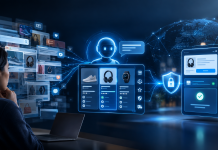
The message in the accompanying visual—“AI CAN IMITATE TRUST. TAKE A MOMENT TO VERIFY.”—captures an important shift in the cybersecurity landscape. Artificial intelligence is not merely making cyberattacks faster. It is changing the economics of deception, impersonation and social engineering.
The distinction matters for corporate leaders because traditional cybersecurity has largely focused on protecting systems, networks, devices and data. The AI era adds another attack surface: human trust itself.
Cybersecurity Awareness Month 2026 is being observed this October under the theme “Don’t Make It Easy for Them,” with the National Cybersecurity Alliance emphasizing repeatable security habits such as strong passwords, multifactor authentication, recognizing scams and keeping software updated.
But for an AI-enabled enterprise, these basic controls now need to be complemented by something equally important:
verification by design.
From Phishing to “Trust Phishing”
Traditional phishing attempts often depended on obvious warning signs—poor grammar, suspicious URLs, strange formatting or an unfamiliar sender.
Generative AI is steadily reducing those signals.
An attacker can now potentially create:
- convincing executive emails;
- realistic voice clones;
- synthetic photographs;
- manipulated videos;
- fake customer-service conversations;
- personalized social-engineering messages;
- fabricated documents;
- convincing professional profiles; and
- multi-channel impersonation campaigns.
The FBI has warned that criminals are using AI-generated voices and publicly available photographs to impersonate known individuals and has advised people to independently verify unexpected requests through previously trusted channels.
This represents an important evolution.
The attacker no longer necessarily needs to break the technology.
They may simply need to persuade the human being operating it.
The New Cybersecurity Perimeter Is Human Trust
For decades, the cybersecurity perimeter was conceptualized around:
Network → Device → Application → Identity → Data
AI introduces another layer:
Trust → Context → Authenticity → Human decision
Consider a hypothetical CFO receiving a voice call that sounds exactly like the CEO:
“I’m in a meeting. Please approve the acquisition payment immediately.”
The request may arrive after an apparently legitimate email and may be followed by a realistic-looking document.
Every individual component could appear authentic.
Yet the entire interaction could be fraudulent.
This is why identity verification and transaction verification cannot depend exclusively on familiarity, appearance or voice.
A familiar face is no longer necessarily proof of identity.
A familiar voice is no longer necessarily proof of identity.
A professionally written email is no longer necessarily proof of authenticity.
The Deepfake Problem Is Becoming an Enterprise Risk
Deepfakes were initially treated primarily as a misinformation or reputational problem.
That interpretation is now too narrow.
Synthetic media can potentially affect:
Financial controls
Fake executive instructions could be used to initiate payments or alter banking information.
Corporate communications
Synthetic statements attributed to CEOs or senior executives could affect employees, investors, customers and markets.
Recruitment
AI-generated identities and documents can complicate employee and contractor verification.
Customer service
Impersonation can be used to obtain account information or manipulate support teams.
Brand reputation
Fabricated video or audio can create false associations between a company and a statement, event or activity.
Executive security
Publicly available photographs, interviews and speeches provide raw material for sophisticated impersonation.
The FBI specifically advises users to verify unusual audio, video and image content through trusted sources rather than relying on the apparent authenticity of the media itself.
The Detection-Only Strategy Has a Fundamental Limitation
One tempting response is:
“We will deploy AI to detect AI.”
That is useful—but insufficient.
NIST’s current research into generative-AI evaluation illustrates why. Its 2026 GenAI evaluations explicitly examine the ability of generated content to become difficult to distinguish from human-created content and assess how convincing misleading narratives can be.
NIST is also evaluating deepfake-detection systems under adversarial conditions. Its 2026 research notes significant degradation in detection performance when systems move from academic evaluation toward operational deployment.
The strategic lesson for executives is straightforward:
A detection system should be one layer of verification—not the entire verification strategy.
The stronger architecture combines:
Detection + provenance + identity verification + behavioural controls + human judgment.
From “Trust but Verify” to “Verify Before You Trust”
The principle sounds simple, but implementing it requires organisational discipline.
A company should identify transactions and decisions where trust must never be based on a single digital signal.
For example:
| Situation | Weak verification | Stronger verification |
|---|---|---|
| CEO requests payment | Voice recognition | Independent callback |
| Vendor changes bank details | Email confirmation | Known contact + dual approval |
| Executive sends urgent document | Email identity | Verified channel + document provenance |
| Customer requests sensitive change | Password/OTP alone | Risk-based identity verification |
| Employee receives unusual login request | Familiar branding | MFA + device/context validation |
| Viral executive video | Visual authenticity | Official corporate confirmation |
| AI-generated report | Plausible language | Source validation + human review |
The objective isn’t to make every interaction bureaucratic.
It is to apply proportionate friction where the consequence of being wrong is high.
The Rise of “Verification by Design”
Organisations should begin treating verification as a component of enterprise architecture.
A useful model is the PAUSE framework:
P — Pause
Do not respond immediately to urgency, authority or emotional pressure.
A — Authenticate
Confirm who is communicating—not merely what account, number or profile appears on screen.
U — Understand the request
Determine what action is actually being requested and what its consequences are.
S — Source-check
Validate the information against an independent, trusted source.
E — Execute safely
Only then authorize the transaction, disclosure, download or decision.
This approach is particularly relevant for finance, HR, procurement, legal, healthcare, government and critical infrastructure environments.
The CEO Impersonation Test
Every organisation should conduct a simple exercise:
What would happen if our CEO’s face, voice, email style and professional history were convincingly replicated tomorrow?
The question should then extend to:
- CFO
- CHRO
- CIO/CISO
- Board members
- key customers
- major vendors
- government officials
- trusted advisers
The resulting exercise can expose gaps that conventional penetration testing may not identify.
Cybersecurity teams should therefore expand red-team exercises beyond technical compromise to include:
identity deception + synthetic media + social engineering + financial manipulation.
AI Agents Make Verification Even More Important
The next phase of the challenge extends beyond deepfakes.
AI agents are increasingly capable of interacting with systems, processing information and performing tasks.
That introduces a new question:
What happens when an AI system is tricked into trusting another AI-generated instruction?
NIST’s 2026 analysis of AI-agent security found broad agreement among respondents that AI agents introduce novel security threats and that traditional cybersecurity principles need adaptation for agentic systems.
This means enterprises may eventually need to authenticate not only:
Human → System
but also:
AI Agent → AI Agent → System
The security architecture of the agentic enterprise will therefore require strong controls around:
- identity;
- authorization;
- provenance;
- permissions;
- auditability;
- data access;
- tool use;
- transaction limits;
- human approval; and
- continuous monitoring.
Content Provenance Could Become a Strategic Trust Layer
Detection asks:
“Does this look AI-generated?”
Provenance asks:
“Where did this content come from, and what happened to it?”
That is a fundamentally different question.
NIST’s work on synthetic-content transparency examines approaches including content authentication, provenance tracking, watermarking, synthetic-content detection and auditing.
For enterprises, provenance could become increasingly valuable for:
- financial documents;
- legal evidence;
- corporate announcements;
- media releases;
- product documentation;
- photographs;
- video communications;
- customer records;
- regulatory submissions.
The strategic direction is therefore moving from content recognition toward content authenticity infrastructure.
Human Behaviour Remains the Critical Variable
Technology alone cannot solve a trust problem created partly through human behaviour.
Interestingly, the cybersecurity awareness challenge remains significant even as awareness increases.
The National Cybersecurity Alliance’s five-year Oh Behave! research found that awareness of MFA increased substantially between 2021 and 2025, while regular MFA use did not keep pace. Its research illustrates a broader cybersecurity challenge: knowing what to do and consistently doing it are different problems.
AI makes that behavioural gap more consequential.
Employees under pressure may still:
- click the link;
- trust the familiar voice;
- approve the urgent payment;
- disclose the information;
- bypass the procedure;
- or assume that someone else has verified it.
Therefore, cybersecurity awareness cannot remain an annual compliance presentation.
It needs to become a behavioural operating system.
What Boards Should Ask the CISO?
The boardroom conversation should evolve from:
“How many cyberattacks did we block?”
to questions such as:
- Can our employees reliably identify AI-enabled impersonation?
- What financial transactions require independent verification?
- Can our executives’ voices and identities be cloned?
- What controls exist against deepfake-enabled fraud?
- How do we establish content provenance?
- Which business processes still rely on trust in email, voice or video alone?
- Can our AI systems be manipulated into taking unauthorized actions?
- Where is human approval mandatory?
- How quickly can we authenticate a suspicious executive communication?
- Have we tested these controls under realistic social-engineering conditions?
These questions transform cybersecurity from an IT issue into an enterprise trust and resilience issue.
A New Corporate Principle: No Single Signal Should Establish High-Stakes Trust
The deeper lesson from AI-enabled deception is that organisations should avoid treating any single signal as definitive proof of identity.
Not:
Voice = Person
Not:
Email address = Person
Not:
Face = Person
Not:
OTP = Intent
Not:
AI detector = Truth
Instead:
High-risk decisions should require multiple independent signals.
For example:
Identity + Context + Device + Behaviour + Independent Confirmation
This is essentially a Zero Trust philosophy applied to human communication.
Zero Trust traditionally tells organisations not to automatically trust a user simply because that user is inside a network.
The AI era may require an analogous principle:
Do not automatically trust a communication simply because it looks, sounds or behaves like someone you know.
The “Pause” May Become the Most Valuable Security Control
Cybersecurity has historically celebrated speed:
- faster detection;
- faster response;
- faster authentication;
- faster automation.
AI introduces a paradox.
Sometimes the safest action is to slow down.
A 30-second verification call can prevent a multimillion-dollar fraudulent transfer.
A second source can prevent an executive from forwarding fabricated information.
A manual confirmation can prevent an AI agent from executing an unintended transaction.
The cost of a small amount of friction can therefore be insignificant compared with the cost of misplaced trust.
The Strategic Imperative for CXOs
For CEOs, CISOs, CIOs and boards, the AI cybersecurity agenda should now encompass three distinct layers:
1. Protect the infrastructure
Secure networks, endpoints, identities, applications and data.
2. Protect the AI
Secure models, prompts, data, agents, APIs and AI-enabled workflows.
3. Protect trust
Authenticate people, validate communications, establish provenance and independently verify high-impact decisions.
The third layer is likely to become increasingly important.
Because the most sophisticated attack may not announce itself as an attack.
It may arrive as a perfectly normal conversation.
Conclusion: Trust Should Be Earned, Not Simulated
Artificial intelligence is creating enormous economic and social opportunities. The objective is not to distrust every digital interaction or treat AI-generated content as inherently malicious.
The objective is more practical:
Match the level of verification to the level of consequence.
For a routine message, ordinary safeguards may be sufficient.
For a request involving money, privileged access, sensitive information, legal commitments or strategic decisions, organisations should introduce stronger independent verification.
The future of cybersecurity will therefore not be determined only by who has the strongest firewall, the fastest SOC or the most sophisticated AI detector.
It will also depend on who has built the strongest culture of verification.
As Cybersecurity Awareness Month 2026 begins, the message is particularly relevant:
AI can imitate trust.
Take a moment to verify.
Pause. Verify. Speak up.
That may be one of the simplest—and most consequential—cybersecurity habits of the AI era.