
Can India Create a Commercially Sustainable UPI Without Undermining What Made It Successful?
India’s UPI monetisation experiment is not simply about introducing MDR. It is about finding an economic model that can fund innovation, resilience and competition without weakening affordability, openness and frictionless merchant acceptance.
By CXO Herald Editorial Desk
India has reached an unusual moment in the evolution of digital payments.
The country has already solved the adoption problem.
What began as a digital payments architecture has become an everyday economic utility used by consumers, small merchants, enterprises, financial institutions and government-linked ecosystems. In August 2026, UPI processed 24.51 billion transactions worth approximately ₹29.82 lakh crore, with 752 banks live on the network. (NPCI)
UPI accounted for 81% of India’s retail digital-payment transaction volume in FY2024-25, according to government data. (Press Information Bureau)
The next problem is harder.
How does India make UPI commercially sustainable without changing the economics that helped make UPI ubiquitous?
That question has moved from theory to policy.
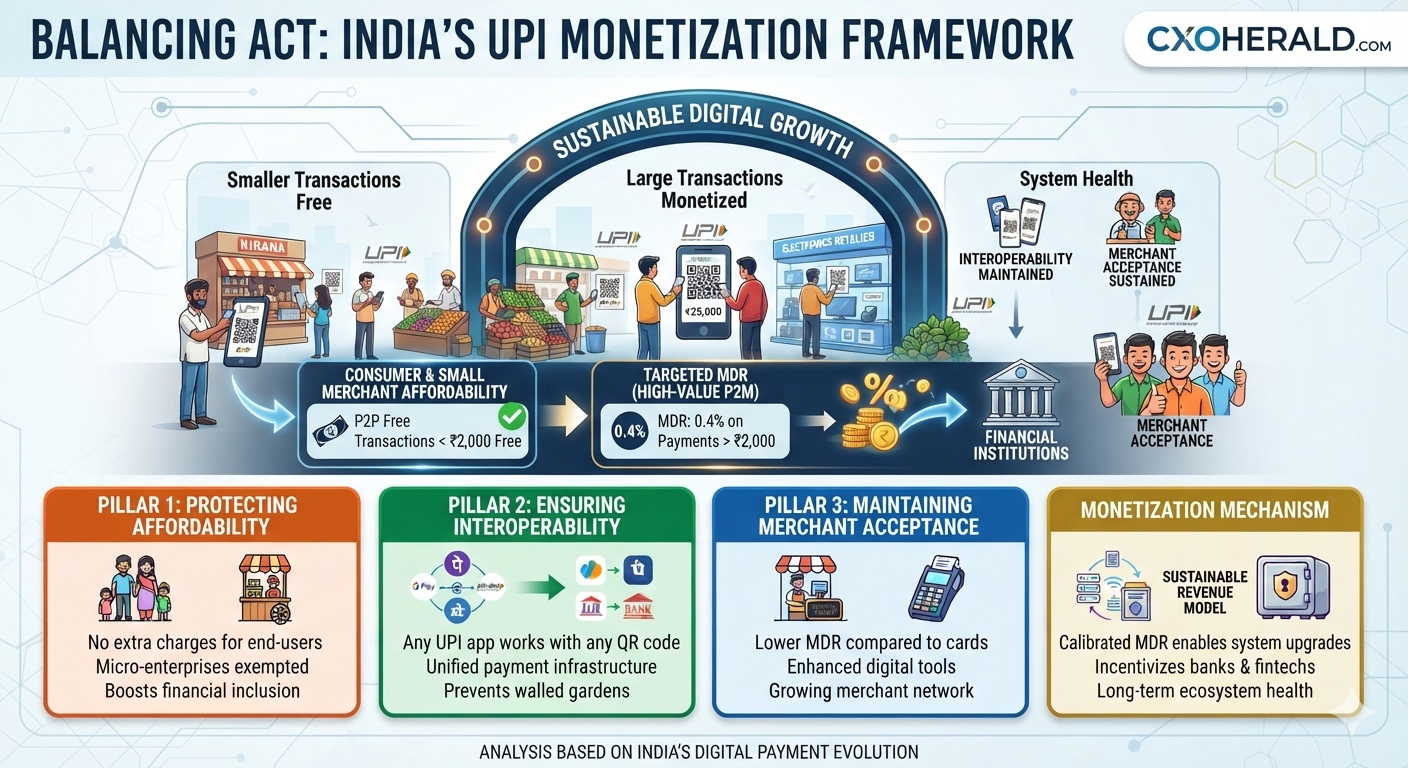
From 15 October 2026, a new Merchant Discount Rate framework is scheduled to apply to specified person-to-merchant UPI transactions above ₹2,000. The standard MDR is 0.4%, capped at ₹300 for transactions of ₹75,000 and above. Person-to-person transactions remain free, while merchant transactions up to ₹2,000 and eligible transactions of small merchants under the zero-MDR framework remain free. The government says approximately 96% of P2M transactions will remain unaffected. (Press Information Bureau)
The policy is therefore not a blanket charge on UPI.
It is something more consequential: an attempt to redesign the economics of one of India’s most important digital public infrastructures.
And that makes the real question much bigger than MDR.
UPI’s Greatest Achievement Was Making Payments Boring
Technology platforms usually succeed by giving users more features.
UPI succeeded partly by taking complexity away.
A consumer does not need to know which bank operates the merchant’s account, which payment service provider is involved, or which application sits between the customer and the underlying payment infrastructure.
Scan.
Enter.
Authenticate.
Pay.
That simplicity has become a competitive advantage in itself.
The merchant side is equally important.
A QR code can turn a small shop, street vendor, professional service provider or neighbourhood business into a digital acceptance point without requiring the merchant to understand the complexity of traditional card-acquiring infrastructure.
The result is a payment system in which interoperability became invisible to the user.
That is precisely what monetisation must protect.
Because the economic value of UPI is not only the revenue generated by payment transactions.
It is also the economic activity enabled by removing friction from those transactions.
The New MDR Framework Changes the Economics — But Selectively
The September 2026 framework deliberately protects the low-value end of the ecosystem.
According to the Ministry of Finance:
- P2P UPI transactions remain completely free.
- P2M transactions up to ₹2,000 remain free.
- Eligible small merchants receiving up to ₹1 lakh per month through UPI QR under the P2PM category remain at zero MDR.
- Approximately 96% of merchant transactions remain outside the MDR framework.
- Eligible P2M transactions above ₹2,000 attract 0.4% MDR.
- Transactions of ₹75,000 and above have a ₹300 cap.
- Specified essential and thin-margin sectors attract a flat ₹5 MDR.
- Capital-market transactions attract 0.02% MDR, capped at ₹300. (Press Information Bureau)
The government has also clarified that MDR is not a government or NPCI tax. It is a charge within the payment ecosystem and is intended to be distributed among participating ecosystem entities. Customers are not supposed to pay the MDR directly. (Press Information Bureau)
This distinction matters.
The framework is attempting to create a revenue mechanism without turning UPI into a conventional consumer-paid payment service.
That is a fundamentally different model from simply putting a transaction fee on every digital payment.
The Most Important Number May Not Be 0.4%
The headline number is 0.4%.
But the more revealing number is 4%.
Government data indicates that MDR will apply to approximately 4% of merchant transactions by volume. (Press Information Bureau)
Moneycontrol’s analysis of August 2026 UPI data found that transactions above ₹2,000 represented approximately 4% of P2M transaction volume but around 67% of P2M transaction value. The number of such transactions had more than doubled over three years. (Moneycontrol)
That creates the economic logic behind the framework.
The policy is targeting a relatively small proportion of transactions by volume while reaching a much larger proportion of merchant-payment value.
In other words:
The objective is not to monetise UPI’s mass-market habit. It is to monetise a higher-value layer of the merchant ecosystem.
That distinction could prove critical.
If millions of ₹50, ₹200 or ₹1,000 payments remain unaffected, the everyday psychological proposition of UPI remains largely intact.
But the larger question is what happens to merchants operating at higher transaction values and lower margins.
Can a 0.4% MDR Really Make UPI Sustainable?
There is a strong economic case for asking this question.
Payments infrastructure is not costless.
Banks, payment service providers, application providers and technology companies must maintain systems capable of processing extraordinary transaction volumes while investing in:
- Cybersecurity
- Fraud prevention
- Infrastructure capacity
- System resilience
- Authentication
- Dispute resolution
- Merchant onboarding
- Customer support
- Product development
- Regulatory compliance
The Reserve Bank of India has previously recognised this structural tension.
Its payments-policy analysis has noted that high payment costs can discourage consumers and merchants from shifting to digital payments, while costs that are too low can become non-remunerative and discourage investment. The RBI described the policy challenge as finding a balance between cost, scale and sustainability. (Reserve Bank of India)
That principle remains relevant.
A payment network that processes billions of transactions but cannot generate enough economic value to sustainably finance its infrastructure eventually faces a different kind of risk.
Free is not necessarily sustainable.
But the reverse is also true:
Monetisation is not automatically sustainable if it reduces usage.
The commercial objective therefore has to be more sophisticated than simply maximising payment revenue.
The Real Business Question: Who Pays?
The framework says the merchant bears the MDR and that banks should ensure merchants do not pass the cost on to customers. UPI application providers are also prohibited from imposing platform fees or hidden charges. (Press Information Bureau)
That provides an important consumer safeguard.
But economics rarely ends with the initial payer.
A merchant facing an additional payment cost has several possible responses:
Absorb it.
Negotiate lower acquiring costs.
Change payment preferences.
Increase operating efficiency elsewhere.
Or attempt to incorporate the cost into pricing.
The first months of implementation will therefore be important.
The key metric should not simply be how much MDR is collected.
It should be whether merchant acceptance and consumer behaviour remain stable.
If merchants continue to display UPI prominently and consumers continue to choose it naturally, the model will have passed an important behavioural test.
If merchants begin discouraging UPI for higher-value purchases, the economics become more complicated.
Why Merchant Acceptance Is the Critical Battleground
UPI’s greatest competitive advantage is not the mobile application.
It is the acceptance network.
A payment method becomes powerful when consumers know it will work almost everywhere.
That creates a network effect:
More merchants accepting UPI → more consumers using UPI → more businesses investing in UPI acceptance → greater utility → even more adoption.
MDR introduces a new variable into that loop.
The question for policymakers and ecosystem participants is therefore:
At what point does the cost of acceptance begin to influence merchant behaviour?
For large enterprises, payment costs can be incorporated into treasury and acquiring strategies.
For a small business operating on thin margins, the same percentage can have a different economic significance.
This is one reason the framework’s small-merchant exemption and sector-specific treatment are important components rather than technical details.
The ₹2,000 Threshold Creates a New Payment-Economics Boundary
The ₹2,000 threshold has another implication.
It creates a visible dividing line between low-value and higher-value merchant transactions.
A ₹1,500 transaction remains outside MDR.
A qualifying ₹3,000 transaction enters the MDR framework.
The system must therefore classify transactions accurately, apply the correct category, calculate the appropriate rate and reconcile the resulting economics between multiple participants.
At scale, this is a technology problem as much as a policy problem.
Payment aggregators, acquiring banks, fintech platforms and corporate accounting systems need reliable transaction classification and reconciliation.
NPCI has indicated that implementation from 15 October provides ecosystem participants time to update software engines and billing systems. (The Indian Express)
This means the quality of implementation could become almost as important as the policy itself.
The Opportunity: Monetise the Value Around UPI
There is another path to commercial sustainability.
Instead of treating UPI primarily as a transaction-fee business, India can increasingly treat it as foundational infrastructure around which higher-value financial services are built.
The transaction itself may be low-cost.
The surrounding services can be valuable.
Consider the possibilities.
Merchant analytics
Businesses can use transaction intelligence to understand revenue patterns, customer behaviour and cash-flow cycles.
Automated reconciliation
Large enterprises can pay for sophisticated reconciliation, accounting integration and treasury-management tools.
Fraud prevention
As transaction volumes grow, advanced risk analytics and fraud-management infrastructure become increasingly valuable.
Working-capital finance
For eligible businesses, consistent digital cash-flow records can become useful inputs into credit assessment.
Embedded finance
Payments can become a distribution layer for lending, insurance, savings and other financial products.
Cross-border payments
UPI’s international acceptance architecture is already expanding, giving Indian payment infrastructure a potential role beyond domestic retail payments. (NPCI)
Enterprise payment infrastructure
Corporates can pay for advanced reporting, controls, reconciliation and payment orchestration without turning basic consumer payments into a heavily monetised experience.
This points toward a more sustainable principle:
Monetise the value created around the payment, not necessarily the act of making the payment itself.
UPI’s Commercial Future May Depend on FinTechs
The zero-MDR environment created a difficult business equation for payment applications.
User acquisition and transaction growth became strategically important, but the underlying payment transaction did not necessarily generate proportional revenue.
The new framework changes that equation for qualifying merchant transactions.
Brokerage estimates cited by Business Standard suggest the new MDR could create an annual revenue pool of roughly ₹15,000 crore to ₹20,600 crore for banks and digital-payment ecosystem participants, although these are estimates rather than realised revenues and depend on transaction mix and implementation. (Business Standard)
That potential revenue pool could change competitive dynamics.
Payment companies may have greater incentives to invest in:
- Merchant acquisition
- Payment reliability
- Fraud prevention
- Business software
- Merchant lending
- Enterprise payment products
- Customer support
- Financial services integration
But it could also introduce new competitive pressures.
If payment companies begin competing primarily on monetisable transaction value rather than user experience, the ecosystem could gradually become less neutral.
That is why openness and interoperability matter as much as monetisation.
Openness Is UPI’s Invisible Economic Asset
UPI works because users are not trapped inside a single payment application.
A merchant’s QR code is designed to be interoperable.
NPCI’s current QR guidelines explicitly retain the consumer-facing principle of “Scan & Pay with any UPI app.” (NPCI)
That is not merely a user-experience feature.
It is an economic design choice.
Interoperability lowers switching costs.
It allows competition between applications.
It reduces the ability of any single platform to control merchant access.
And it creates a common payment language across the ecosystem.
Commercial sustainability should therefore not come at the cost of interoperability.
The moment merchants or consumers begin encountering payment-specific silos, UPI’s network effect starts losing some of its value.
Affordability Is More Than a Zero-Fee Number
There is a temptation to define affordability as simply “no charge.”
The economics are broader.
A payment is affordable when:
- The consumer does not face unexpected charges.
- The merchant can accept the payment economically.
- The payment infrastructure remains reliable.
- Fraud losses remain manageable.
- Dispute resolution works.
- Businesses do not need to maintain multiple expensive payment systems simply to preserve acceptance.
This is why the affordability debate cannot be reduced to whether consumers personally see an MDR line item.
The broader question is:
What is the total economic cost of using digital payments?
That includes explicit fees, merchant costs, operational costs, fraud losses and technology investment.
A sustainable UPI must minimise the total friction of digital commerce, not merely eliminate one visible fee.
The Macro-Economic Case for Protecting UPI’s Low-Friction Model
UPI has effects beyond the payments industry.
Digital payments can contribute to formalisation by creating transaction records.
They can improve the visibility of business cash flows.
They can support digital accounting and reconciliation.
They can help connect merchants with formal financial services.
And they can reduce some of the operational frictions associated with cash.
The Reserve Bank has previously linked India’s digital-payment expansion with financial inclusion, affordability, convenience and broader economic formalisation. (Reserve Bank of India)
That makes UPI’s economic value difficult to capture in a payment-company income statement alone.
If a small business becomes more digitally visible and subsequently gains better access to formal finance, for example, the economic benefit extends well beyond the original payment transaction.
That is why UPI should be evaluated as digital economic infrastructure, not merely as a payment product.
Five Tests for a Commercially Sustainable UPI
The next phase of UPI should be evaluated against five measurable outcomes.
1. Merchant acceptance
Does the number of merchants accepting UPI continue to expand?
More importantly, do merchants continue to actively prefer UPI for customer payments?
2. Consumer behaviour
Do consumers continue choosing UPI across transaction sizes?
The critical signal will be whether higher-value transactions migrate disproportionately to alternative payment methods.
3. Ecosystem investment
Does new MDR revenue translate into measurable investment in infrastructure, cybersecurity, reliability and innovation?
Revenue without reinvestment would weaken the sustainability argument.
4. Competition
Does monetisation strengthen competition among banks, fintechs and payment applications?
Or does it encourage concentration and platform dependence?
5. Inclusion
Does UPI continue expanding among micro-merchants, street vendors, smaller cities and digitally underserved communities?
A commercially successful payment system that becomes less inclusive would represent a different kind of outcome.
What CXOs Should Watch After 15 October 2026
For business leaders, the MDR transition should not be treated as merely another payment-cost change.
CFOs should reassess payment-cost structures, reconciliation and treasury economics.
CIOs and CTOs should examine transaction classification, integration and payment-routing systems.
Chief Digital Officers should monitor changes in customer payment behaviour.
CMOs and commerce leaders should watch for any change in checkout conversion across payment methods.
FinTech founders should reassess merchant economics and potential new revenue models.
Banking leaders should consider how MDR revenue can translate into infrastructure and service investment.
And boards should view payment infrastructure as part of enterprise resilience rather than a purely transactional utility.
The Bigger Strategic Question
India’s UPI journey has moved through three distinct phases.
Phase One: Adoption
Make digital payments easy enough for ordinary people to use.
Phase Two: Scale
Build a payment network capable of processing billions of transactions.
Phase Three: Sustainability
Create economic incentives for banks, fintechs and technology providers to continue investing in the infrastructure.
India is now entering the third phase.
The danger is assuming that sustainability means simply attaching a price to transactions.
It does not.
A commercially sustainable UPI needs an economic model in which the network remains:
Affordable enough to use.
Open enough to compete.
Reliable enough to trust.
Profitable enough to invest in.
Inclusive enough to keep expanding.
That is a much harder equation than simply deciding an MDR rate.
Can India Have Both Free-Looking Payments and Sustainable Economics?
The answer may ultimately depend on what India chooses to monetise.
If the strategy is to extract increasing revenue from the core payment experience, friction could gradually increase.
If the strategy is to monetise higher-value merchant flows selectively while building businesses around reconciliation, analytics, fraud prevention, credit, enterprise services and cross-border payments, the economics could look very different.
The September 2026 framework is an important experiment because it attempts to draw precisely that distinction.
It protects P2P payments.
It protects low-value P2M payments.
It protects eligible small merchants.
And it places MDR primarily on higher-value merchant transactions. (Press Information Bureau)
Whether that balance succeeds will not be determined by the policy announcement alone.
It will be determined in India’s shops, restaurants, hospitals, fuel stations, e-commerce checkouts, service businesses and corporate payment systems.
The ultimate test is behavioural:
Will consumers still instinctively choose UPI?
Will merchants still instinctively accept it?
Will banks and fintechs have stronger incentives to invest in it?
If the answer to all three remains yes, India may demonstrate that digital public infrastructure does not have to choose between affordability and commercial sustainability.
But if monetisation begins to create friction, the network effect that made UPI powerful could become the very thing that makes the economics difficult to change later.
CXO Herald Takeaway
The future of UPI is not a choice between “free” and “paid.” It is a question of where economic value is captured.
India has built something rare: a payment network whose interoperability and low friction have made digital transactions almost invisible to the user.
The next challenge is to build a business model around that infrastructure without making the infrastructure itself less attractive.
The September 2026 MDR framework is therefore more than a pricing change.
It is a test of whether India can commercialise digital public infrastructure without compromising the openness, affordability and simplicity that created its scale.
The strongest long-term model may be one in which:
Consumers retain frictionless payments.
Small merchants retain affordable acceptance.
Banks and fintechs receive sustainable economic incentives.
Technology providers invest in security and innovation.
And the wider Indian economy continues to benefit from digital formalisation and lower payment friction.
The principle is simple:
Do not monetise away the network effect. Monetise the value the network creates.
That is the real UPI sustainability challenge—and potentially one of the most important digital-economics experiments in the world.