
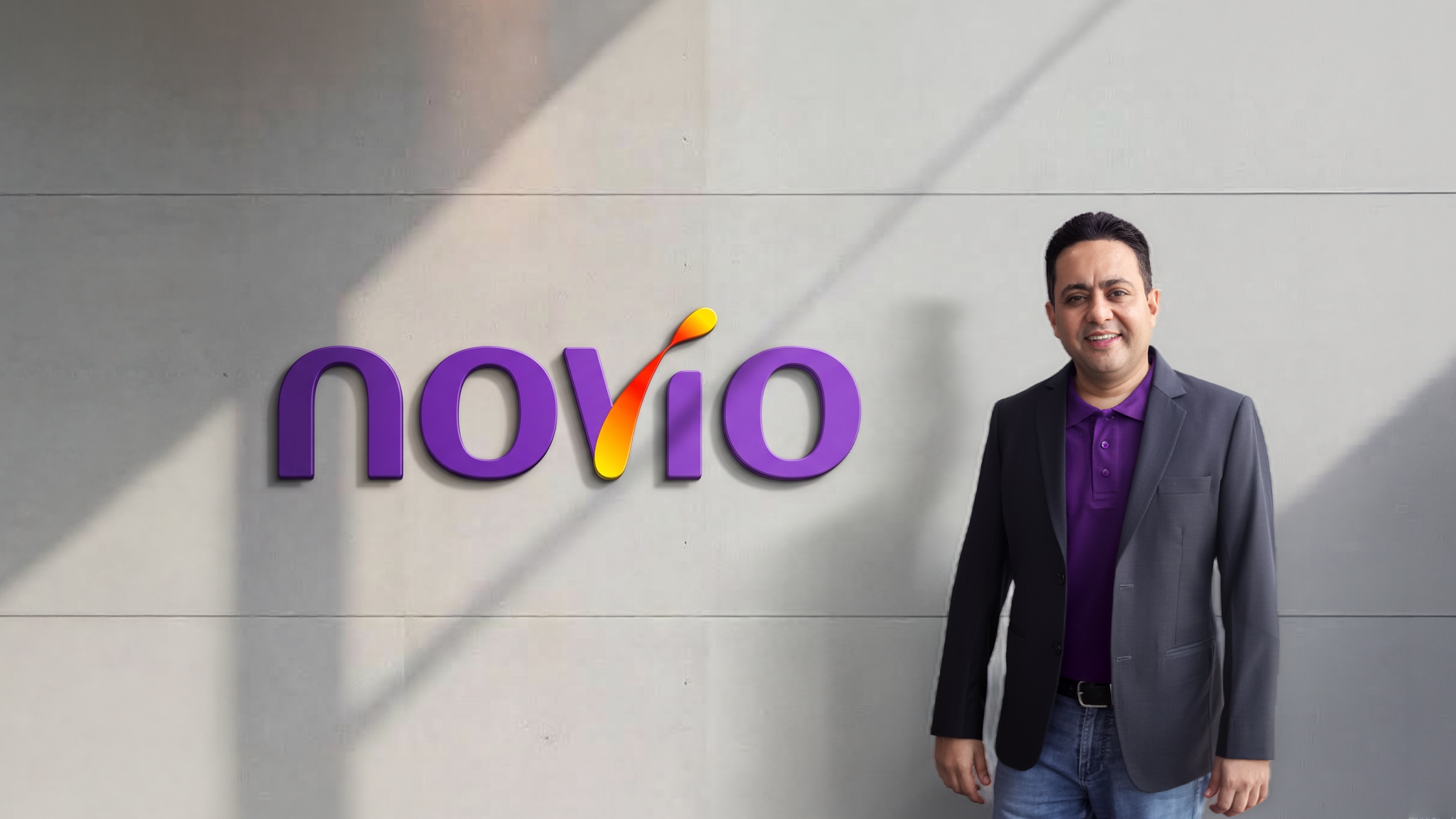
India has built one of the world’s largest digital payments ecosystems, with UPI becoming part of everyday financial life for millions of consumers. The next challenge is increasingly about what comes after the payment: access to formal credit, the ability to build a credit history, and the opportunity to participate more fully in the country’s formal financial system. That is the space in which fintech company novio, powered by Credilio Financial Technologies, is positioning itself.
The company describes its offering as an India-focused, UPI-first fixed-deposit-backed credit-card platform. Its model allows customers to open a fixed deposit and receive a RuPay credit card, with the product also designed to work with UPI. novio says its proposition is aimed particularly at consumers who may not have an established credit history or conventional income documentation, including early-job professionals, students, freelancers, gig workers and small-business owners.
In April 2026, novio announced a ₹100 crore Series A led by Cornerstone Ventures, with participation from Shepherd’s Hill Private Equity, ESV-Arthya AIF and Roots Ventures, alongside venture debt from Innoven Capital and Alteria Capital. The company said the funding would support expansion into Tier 2–5 markets, product development, bank partnerships, its UPI stack and AI-led credit advisory capabilities.
The company’s current stated ambition is considerably larger than simply issuing cards. novio says it wants to help expand access to formal credit while helping consumers build stronger credit profiles and eventually qualify for other financial products.
In this CXO Herald conversation, Aditya Gupta, Founder & CEO, novio, discusses the credit-access gap, the evolution of UPI-linked credit, secured credit as an entry point, responsible borrowing, India’s next generation of credit consumers, fintech-bank partnerships, technology and the road ahead etc. Have put up few responses given by him during this interactive interview :
1. “India has solved much of the access-to-payments problem through digital infrastructure. Is the next big opportunity to turn digital payment behaviour into responsible access to credit?”
Yes, I believe that is one of the big opportunities ahead. India has built extraordinary digital rails for payments, and millions of consumers now have a digital financial footprint even if they do not yet have a conventional credit history.
The opportunity is to use this growing digital footprint to understand consumers better. For example, MCC level UPI transactions, bill payments and settlements can provide additional context around a consumer’s financial behaviour and complement traditional credit information.
But these should be additional signals, not substitutes for assessing affordability, existing obligations and repayment capacity. The objective isn’t to turn more digital transactions into more borrowing; it is to build a more complete picture of the individual and determine whether credit is appropriate, how much is appropriate and in what form.
For consumers who still don’t have sufficient conventional credit history, secured credit can provide another responsible entry point. An FD-backed credit card gives them access to a defined amount of credit, while their subsequent spending and repayment behaviour can help them establish a formal credit history.
So, the opportunity is ultimately not just more access to credit, but better-informed and more responsible access to credit.
2. “Can AI and alternative data genuinely democratise credit, or could they simply create a new form of algorithmic exclusion?”
AI can potentially serve a wide mandate in credit business, but I believe its first step should be to make customer level decision-making more consistent, with agents built to assist the credit process, specifically the underwriter. Credit decisions need consistency at scale, and a human-in-the-loop approach is a good starting point – AI can synthesize large amounts of information, surface relevant signals and support the decision-maker, while keeping judgement and accountability with people.
This becomes particularly useful where relevant information already exists but is fragmented or unstructured. In areas such as business and self-employed lending, there can be information across GST returns, Udyam data, Account Aggregators, and other sources such as e-way bills, merchant transaction data, utility bills, etc. AI can help bring these signals together much faster, allowing an underwriter to make a more informed and consistent decision.
Retail credit could be the next threshold. But this is also where the risk of algorithmic exclusion becomes important. Most AI models are trained on historical data, and if that data does not adequately represent India’s diverse consumer base, we could end up automating existing biases rather than expanding inclusion.
So, the question is not simply whether AI can democratise credit. It is how lenders use it -what data goes into the model, how decisions are validated, and where humans remain in the loop. Those choices will determine whether AI leads to smarter inclusion or creates a new form of exclusion.
3. “Digital lending has grown rapidly, but so have concerns around over-borrowing. How should fintechs measure responsible growth?”
There is a hard truth that the industry needs to acknowledge: a customer who does not get credit from one bank or NBFC does not necessarily stop borrowing. They may simply seek credit from another lender. The challenge is that each lender is typically assessing the customer through its own risk model and its own view of the customer’s obligations.
A customer may therefore be considered acceptable by multiple lenders independently, while the combined level of borrowing may become difficult to sustain. That is where over-approval can translate into over-borrowing.
Every lender has a risk model that determines the level of risk it is willing to take at a particular price. For fintechs and NBFCs, this becomes even more relevant because their cost of capital can be significantly higher than that of banks, and they often serve different customer segments. So, there is not always direct competition for the same customer.
This is why I believe “responsible growth” can sometimes be a misleading term if we only look at an individual lender’s portfolio. A lender may have healthy portfolio performance while the customer is simultaneously becoming over-leveraged across the ecosystem.
Responsible growth therefore has to be measured beyond disbursals and portfolio performance – through the customer’s ability to sustainably service credit, the level of existing obligations, appropriate credit limits and repayment behaviour.
Ultimately, the objective should not simply be to lend more. It should be to grow credit in a way that keeps both the borrower and the lending ecosystem healthy.
4. “What can a fintech like novio do differently from a traditional bank or NBFC when it comes to underwriting an individual who has little or no conventional credit history?”
For someone with little or no conventional credit history, the fundamental challenge is that the absence of a credit history can itself become a barrier to getting the first credit product.
At novio, we see secured credit as an important way of addressing that first step. Instead of relying on an existing bureau history to determine whether someone can access credit, a secured card creates a controlled starting point. The consumer provides an FD, receives a defined credit limit against it, and then their actual behaviour – spending, utilisation and repayment – starts creating a credit track record.
That changes the underwriting question. It is no longer only about predicting behaviour from a historical credit file; it is also about creating a structured environment in which a consumer can demonstrate responsible credit behaviour.
A fintech can build this journey digitally and make it accessible at scale, while continuously using relevant behavioural signals to understand the customer better. Over time, that creates something valuable for both sides: the consumer gets a pathway into formal credit, and the lender gets a progressively richer understanding of that consumer.
For me, that is where fintechs can genuinely complement the traditional credit ecosystem – not by replacing conventional underwriting, but by creating better pathways for people who are still outside it.
5. “If we meet again in 2030, what do you think will have fundamentally changed about how Indians borrow money?”
I think COVID was a watershed moment for the Indian credit ecosystem. Before COVID, many consumers had never really experienced what happens when their ability to repay is disrupted. For some, that period severely affected their credit history and, consequently, their ability to access credit later. Lenders too went through a long cycle of recalibrating portfolios and building healthier books.
One important lesson came out of that period: credit is not just about getting access to money; it is about preserving your ability to access money in the future.
That lesson is increasingly reaching younger consumers. A consumer under 30 today is growing up in a very different credit environment. They are exposed to much more information about credit scores, repayment behaviour, EMIs, borrowing mistakes and financial products through social media and digital platforms. Social media has its own risks when it comes to financial information, but it has also played a meaningful role in making credit more visible and understandable.
By 2030, I expect the typical borrower to be considerably more aware of the consequences of their credit behaviour. They will think not just about whether they can get a loan today, but about how today’s borrowing affects tomorrow’s access.
That should lead to improvement on both sides. Lenders will have better data and better tools to assess risk, while borrowers will have greater awareness of how to manage credit. If that happens, the evolution of Indian credit will not simply be about more people borrowing. It will be about better-quality lending and better-quality borrowing.
CXO HERALD EDITORIAL TAKEAWAY ON NOVIO
The larger story behind novio is the evolution of India’s digital-finance journey.
The first phase was about digitising payments.
The next phase is increasingly about digitising access to financial products.
For a large population of first-time or thin-file borrowers, the challenge is not necessarily the absence of digital transactions. It is the ability to translate financial activity, savings and responsible repayment behaviour into access to formal credit.
novio is attempting to address that gap through an FD-backed credit model combined with UPI and other digital capabilities. Its current strategy also points toward a broader ambition: moving consumers from an entry-level secured credit product toward a longer-term relationship with formal credit.
The company’s stated growth targets make the next phase particularly significant. The challenge will be to demonstrate that access, customer experience, responsible credit behaviour and sustainable fintech economics can scale together.
That is ultimately the more consequential question for India’s consumer-finance ecosystem: not simply how many cards can be issued, but how effectively digital financial infrastructure can help more consumers participate in formal credit without compromising responsible borrowing.
FOUNDER PROFILE
Aditya Gupta
Founder & CEO, novio
Aditya Gupta is the Founder & CEO of novio, the consumer-finance brand powered by Credilio Financial Technologies.
According to novio, Gupta previously built TranServ, a digital-payments enterprise working with banks, NBFCs and e-commerce companies. His professional experience also includes HSBC Bank, ICICI Bank and Maruti Suzuki.
At novio, his focus is on expanding access to formal credit through technology-led consumer-finance products, with the company’s current strategy centred on fixed-deposit-backed credit cards, UPI, credit-building and expansion beyond India’s major metropolitan markets.