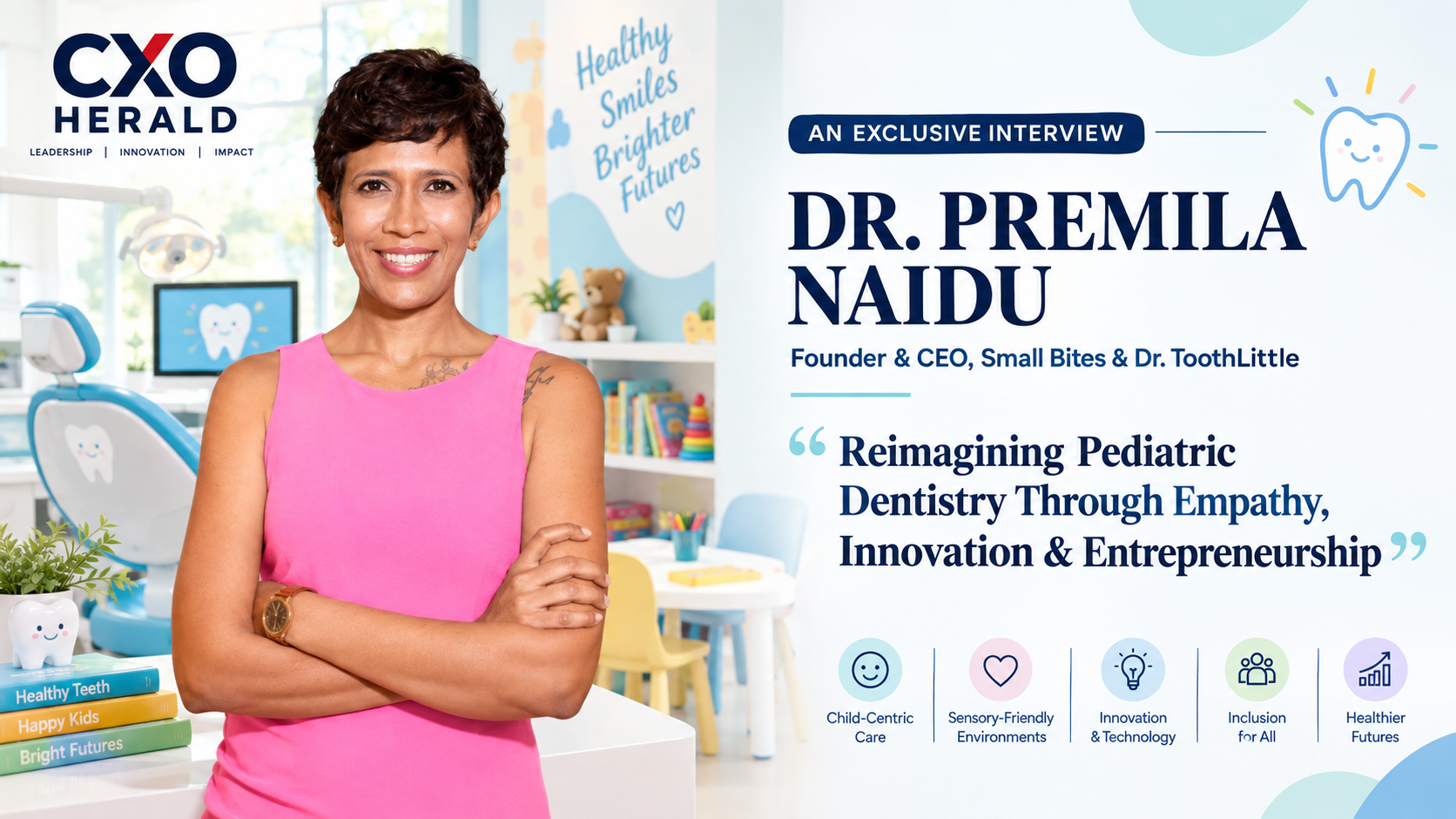
Reimagining Pediatric Dentistry Through Empathy, Sensory-Friendly Care and Entrepreneurship.
In an exclusive CXO Herald interview, Dr. Premila Naidu, Founder of Small Bites and Dr. ToothLittle, discusses pediatric dentistry, sensory-friendly care, healthcare entrepreneurship, technology and building trust with children and parents.
“Children need nothing but the best when it comes to their health and the care of their teeth.” — Dr. Premila Naidu
Introduction of DR. Premila Naidu.
Pediatric dentistry is often described as a clinical specialty. But for Dr. Premila Naidu, the challenge extends well beyond treating teeth.
It is about changing how children experience healthcare.
As the Founder of Small Bites and Dr. ToothLittle, Dr. Naidu has built her professional journey around a simple but consequential idea: children should not have to adapt to intimidating clinical environments; healthcare environments should be designed around children’s physical, emotional and developmental needs.
Small Bites says it was founded by Dr. Naidu in 2007 and describes its clinics as child-focused dental experience centres designed around multisensory, playful and stress-reducing environments. Its current network includes Small Bites and Dr. ToothLittle locations in Bengaluru.
Dr. Naidu completed her master’s in Preventive and Pediatric Dentistry from Rajiv Gandhi University of Health Sciences in 2009. Her published professional profile also records experience with major hospital groups and work involving children with special healthcare needs.
Her work has increasingly brought together clinical dentistry, behavioral understanding, sensory-sensitive design, technology and entrepreneurship.
That intersection makes her story relevant not only to healthcare professionals but also to founders, CXOs and business leaders attempting to understand how specialized healthcare brands can be built around experience and trust.
CXO Herald Exclusive
Dr. Premila Naidu on Building a New Model for Pediatric Dental Care.
From Dentist to Healthcare Entrepreneur
- What made you take the entrepreneurial route and build Dr ToothLittle and Small Bites? What gap did you observe?
My journey into entrepreneurship came from what I was seeing in my clinic every day. Children were often anxious even before treatment began and parents were struggling to find dental care that was designed around a child’s emotional and sensory needs. I felt we needed to rethink the entire dental experience, not just the treatment. That led to Small Bites and later Dr ToothLittle.
- Was the sensory-friendly model driven by clinical experience, patient feedback, or an entrepreneurial opportunity?
It was primarily driven by clinical experience and listening to children and parents. We saw that the environment itself could sometimes create anxiety. The business opportunity came later. When you solve a genuine patient problem well, a sustainable business model can follow.
- What were the biggest challenges in converting your clinical philosophy into a scalable healthcare business?
The biggest challenge was ensuring that the philosophy remained consistent as we grew. It is easy to create a good experience in one clinic when you are personally involved. The challenge is building processes, training teams and creating a culture where the same standard of care is delivered every time.
- How different is running a healthcare enterprise from practicing dentistry?
They are very different. As a dentist, my focus was primarily on one patient at a time. As an entrepreneur, I have to think about patients, people, processes, finances, technology, brand and growth, all while ensuring that clinical quality remains non-negotiable.
The Sensory-Friendly Pediatric Dental Model
- What exactly makes Dr. Toothlittle and Small Bites sensory-friendly?
Sensory-friendly care means designing the dental experience around how a child sees, hears and experiences the environment. We pay attention to things such as sound, light, colours, smells, communication and the way procedures are introduced. The objective is simple: make the child feel safe and in control.
- What are the biggest sensory triggers during a conventional dental visit?
The sound of the dental equipment, bright lights, unfamiliar smells, unfamiliar people and the feeling of someone working inside their mouth can all be overwhelming. Sometimes even the waiting room can be a trigger. Every child is different, which is why we try to understand the child rather than follow one standard approach.
- How does sensory-friendly dentistry change the child’s experience?
It changes the visit from something the child fears to something they can understand and participate in. We prepare them, explain what is going to happen and give them time to get comfortable. The treatment is important, but how the child experiences that treatment is equally important.
- How do you approach children with autism, ADHD, developmental differences or dental anxiety?
We don’t believe in a one-size-fits-all approach. We first try to understand the child’s communication style, triggers, comfort levels and previous experiences. We then adapt our environment and communication accordingly. Patience is often as important as the clinical intervention.
- Can modifying the environment reduce the need for behavioural management or sedation?
In some children, reducing sensory triggers and building trust can make cooperation much easier and may reduce the need for more intensive behavioural interventions or sedation. But this has to be assessed individually. Sedation or other interventions should never be viewed as something to avoid at all costs when they are clinically appropriate.
- How do you train dentists and staff?
We focus not just on clinical skills but on communication and observation. Our teams need to understand that a child’s behaviour is often a form of communication. We train them to recognise anxiety, give children time, explain procedures in simple language and respond with patience rather than pressure.
- What role do parents play?
Parents are partners in the process. They know their child best and can tell us what triggers them, what comforts them and how they communicate. We also encourage parents to speak positively about dental visits and avoid transferring their own fears to the child.
The Business of Pediatric Healthcare
- How large is the opportunity for paediatric dentistry in India?
The opportunity is significant because the need is much larger than the current level of specialised care. India has a very large child population, and oral health is an important part of overall health. Parents are also becoming more aware of preventive and specialised paediatric care.
- What have you learnt about consumer behaviour when parents make the healthcare decision?
Parents are looking for much more than a technically competent doctor. They want someone they can trust with their child. They look at the environment, communication, safety, convenience and how their child feels after the visit. In paediatric healthcare, the parent is choosing the experience as much as the treatment.
- How do you balance clinical outcomes, child experience and commercial sustainability?
For us, clinical quality comes first. But a healthcare business also has to be financially sustainable to serve patients over the long term. I don’t see patient experience and commercial sustainability as opposites. If you create genuine value for families and build trust, the business can grow around that value.
- What are the economics of a specialised paediatric dental facility compared with a conventional clinic?
A specialised centre requires greater investment in infrastructure, equipment, trained people and the overall patient experience. But it also creates a differentiated proposition. The key is to ensure that the investment translates into better clinical outcomes, better patient experience and long-term patient relationships.
- Is there a premium for sensory-friendly care?
There can be an additional cost because of the specialised infrastructure and trained teams. But our objective is not to make specialised care accessible only to a small section of society. As we scale, we want efficiencies to help make this model increasingly accessible.
- What business decisions have been most important to your growth?
One important decision was to stay focused on our area of expertise rather than trying to be everything to everyone. Another was investing in people and processes. We have also understood that building trust in healthcare takes time. Growth should not come at the cost of the experience we promise families.
- Do you see opportunities beyond Bengaluru?
Definitely. The need exists across India. The question is how we expand while maintaining our clinical and experience standards. We are open to different models of expansion, provided the quality and philosophy remain consistent.
Technology & Innovation
- What role can technology play in making pediatric dentistry less intimidating?
Technology can make the experience more predictable and personalised. Digital records, visual explanations, virtual familiarisation and better diagnostics can help children and parents understand what to expect. Technology should support the human interaction, not replace it.
- Can AI, digital diagnostics and virtual consultations improve outcomes?
Yes, particularly in diagnostics, documentation, treatment planning and follow-ups. AI can help clinicians identify patterns and support decision-making, but clinical judgement and the doctor-child relationship will remain central.
- Could every child eventually have a personalised sensory profile?
I think that is a very interesting possibility. If we could capture information about a child’s sensory preferences, communication style, previous dental experiences and triggers before the appointment, the clinical team could prepare much better. It could make the entire experience more personalised.
- What global innovations should India adopt?
I would look beyond just technology. Globally, there is a lot of emphasis on child psychology, preventive care, minimally invasive dentistry and designing healthcare environments around the patient. India can learn from these approaches and adapt them to our own context.
Healthcare Entrepreneurship & Market Trends
- Why is specialised outpatient care an interesting entrepreneurial opportunity?
Outpatient healthcare is closer to the everyday healthcare needs of people. It can also be more focused and specialised than a large hospital model. As awareness grows, families are looking for specialists who understand specific needs rather than generalised care.
- What are the biggest misconceptions investors and entrepreneurs have about clinical healthcare?
Healthcare cannot be built purely like a technology business. You cannot compromise on clinical quality for speed of growth. Trust takes time, people matter enormously and clinical processes need to be consistent. The business model has to work within those realities.
- What makes a healthcare venture genuinely scalable?
A clear clinical philosophy, standardised processes, strong people practices, training and quality systems. Scalability should not mean simply opening more centres. It means being able to replicate the quality of care and experience.
- How important are patient experience, brand trust and community engagement?
They are fundamental. In healthcare, your brand is ultimately built by the experiences of patients and families. Community engagement also helps educate parents about prevention rather than making healthcare only a treatment conversation.
- Are parents more willing to pay for specialised healthcare experiences?
I think parents are increasingly willing to invest in specialised care when they understand the value it brings to their child. But affordability still matters. The industry needs to find ways to offer specialised care without making it inaccessible.
Women Entrepreneurs & Leadership
- What unique challenges did you encounter as a woman healthcare entrepreneur?
Like many women entrepreneurs, I have had to constantly balance multiple responsibilities and prove that a woman can be both clinically driven and commercially ambitious. Over time, I have learnt that credibility comes from consistency, knowledge and the value you create, not from trying to fit into someone else’s definition of leadership.
- What lessons from clinical practice influence your leadership style?
Dentistry has taught me patience, attention to detail and the importance of listening. Every patient is different, and I carry the same principle into leadership. People need to be understood before they can be guided.
- What advice would you give young women dentists?
Don’t be afraid to think beyond the clinic. If you have identified a problem and genuinely believe you can solve it, explore it. But build your clinical credibility first and be willing to learn the business side. Entrepreneurship is a continuous learning journey.
- What did you have to learn that dental school didn’t teach you?
Almost everything related to running a business finance, people management, marketing, operations, strategy and leadership. Dentistry teaches you how to treat a patient. Entrepreneurship teaches you how to build an organisation around that purpose.
Growth, Scale & Future Vision
- What is your five-year vision for Dr. Toothlittle and Small Bites?
I would like to see sensory-friendly paediatric dental care become more accessible to families across India. Our ambition is not simply to build more clinics, but to build a strong model of specialised paediatric dental care that can be replicated without losing its human touch.
- Are you looking at franchising, company-owned centres, hospitals or technology-enabled expansion?
We are open to a combination of models. Company-owned centres give us greater control, while partnerships and other models help us reach more families. Technology will also play an important role in enabling the model. But whichever route we take, quality will remain the filter.
- Could sensory-friendly dentistry become standard rather than specialised?
Absolutely. I would actually like to see the term “sensory-friendly” become less necessary over time. Understanding a child’s sensory and emotional needs should ideally become part of good paediatric dental practice itself.
- What does success look like beyond clinics and patient numbers?
Success would be changing how children perceive a dental visit. If a child who was once frightened can walk into a dental clinic without fear, that is meaningful success for me. I would also like to see more dentists and healthcare professionals adopt child-centred approaches.
- If you could change one thing in India’s paediatric dental ecosystem, what would it be?
I would make prevention and early dental visits a normal part of childhood rather than waiting until there is a problem. We need to move from treating dental disease to building lifelong oral health habits.
Closing Questions
- What is the one thing you wish every parent understood before bringing their child to the dentist?
Don’t wait for a dental problem. A child’s first dental visit should ideally happen before there is pain or an emergency. It allows the child to build a positive relationship with the dentist and makes prevention much easier.
- What has dentistry taught you about entrepreneurship and entrepreneurship taught you about being a doctor?
Dentistry taught me to listen, observe and be patient. Entrepreneurship taught me to think bigger and to look at the larger system around the patient. Both have reinforced the same lesson for me: understand the person in front of you before deciding what they need.
- If Dr. Toothlittle and Small Bites succeeds at the scale you envision, what change would you like it to create?
I would like children to stop seeing the dentist as someone they need to be afraid of. I want parents to see dental care as an important part of their child’s overall health, and I would like sensory-friendly, child-centred care to become a normal expectation in paediatric dentistry in India.
Dr. Premila Naidu: The Larger Leadership Story
Dr. Premila Naidu’s journey reflects a broader transformation taking place across healthcare.
The healthcare organization of the future cannot compete only on clinical capability.
It must also compete on:
trust, experience, accessibility, specialization, technology and empathy.
Her approach to pediatric dentistry demonstrates how these elements can intersect.
The physical clinic becomes part of the treatment experience.
The clinical team becomes part of the trust architecture.
Technology becomes an enabler rather than an end in itself.
And the founder’s role evolves from practitioner to designer of an ecosystem.
That may be one of the most important lessons for healthcare entrepreneurs.
A successful healthcare brand is not built simply by opening more clinics.
It is built by answering a much more fundamental question:
What should healthcare feel like for the person receiving it?
For pediatric dentistry, Dr. Naidu’s answer has been to create an environment in which children can feel more comfortable, parents can feel more informed and clinicians can deliver specialized care with greater sensitivity.
That is a healthcare proposition—and a leadership philosophy—that extends well beyond dentistry.
About Dr. Premila Naidu
Dr. Premila Naidu is a preventive and pediatric dentist and Founder/Director associated with Small Bites. Her published profiles state that she completed postgraduate training in Preventive and Pediatric Dentistry in 2009 and has worked extensively with children with special healthcare needs. She has also been recognized with a dental excellence award for pediatric dentistry in Bengaluru.
About Small Bites and Dr. ToothLittle
Small Bites describes itself as a specialized pediatric dental organization founded by Dr. Premila Naidu in 2007. Its current model combines pediatric dental treatment with child-focused, multisensory environments, preventive care and specialized approaches for children with developmental and special healthcare needs.
Official website: Small Bites / Dr. ToothLittle