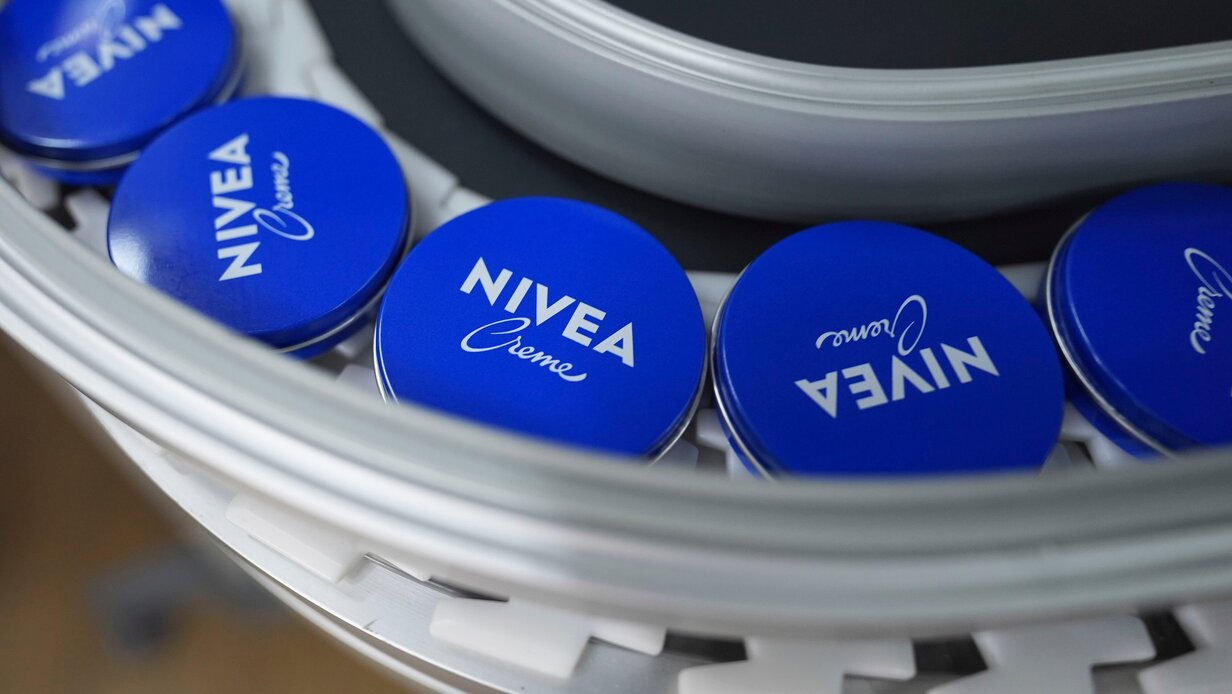
Nivea is losing more and more market share to its younger competitors. Beiersdorf is adjusting its premium strategy and promising a turnaround. But the traditional brand’s problem runs deeper.
Creams, serums, and masks are more popular than ever. On social media platforms like Instagram and TikTok, hundreds of influencers can be seen daily demonstrating skincare routines that often consist of up to ten steps and sometimes take almost an hour. Generation Z wants to live healthily and takes a holistic approach, encompassing everything from good nutrition and fitness to exercise and skincare.
However, not all market participants benefit from this self-care trend. The greater the attention given to skincare, the fiercer the competition becomes. New brands are flooding shelves with ever-faster product cycles, and social media hype is shifting demand into weeks rather than years.
One of the losers: Nivea The brand is one of the largest and most established skincare brands in the world, but it is currently barely benefiting from the boom. In the first half of 2026, sales of the skincare brand, including Labello, fell by around seven percent. Even in the 2025 fiscal year, Nivea had only grown by 0.9 percent.
This is a hard blow for manufacturer Beiersdorf, as Nivea contributes more than half of the group’s revenue. Consequently, weaknesses in the core brand have a significant impact on the overall balance sheet. At the beginning of the week, the Hamburg-based consumer goods company lowered its forecast for 2026 when presenting its half-year results.
Instead of stability, Beiersdorf now expects a sales decline “in the low single digits.” This is the third time within a year that the DAX-listed company has had to revise its expectations downwards. Beiersdorf had already lowered its forecast for fiscal year 2025 in the summer and autumn.
“We clearly made a bet,” said CEO Vincent Warnery at the presentation of the financial results on Wednesday. Beiersdorf had focused on high-quality facial care to transform the brand, previously more associated with body care, into a skincare brand. Nivea’s focus had recently been on higher-priced premium products, for which Beiersdorf developed the two active ingredients Epicelline and Thiamidol.
This worked exceptionally well until 2024: Under the Frenchman’s leadership, Beiersdorf came close to the ten billion euro revenue mark for the first time. The Herz family, which holds its majority stake in Beiersdorf through the Maxingvest holding company, subsequently extended the manager’s contract ahead of schedule. Warnery is expected to continue until 2030.
Then came 2025. Beiersdorf had to acknowledge that there isn’t a market for premium facial care “everywhere,” said the CEO. The company could no longer afford to spend so much money on skincare “at the expense of other categories.” Therefore, they changed their strategy and reinvested more in other business areas such as deodorant and shower gel.
Today, no one at Beiersdorf wants to talk about premiumization anymore; quite the opposite. The board now has to admit that they went too far with price increases. “We see that this overinvestment in premium facial care has, in a way, damaged Nivea’s value-for-money positioning,” said Warnery.
Nivea as a caring mother
Nivea is in a phase “where the brand has lost sight of its identity,” says Christopher Spall, brand expert and owner of the consultancy “Spall Identity.” While the market for “science-based skincare” may offer high margins, it’s not the right one for Nivea.
Strong brands, Spall argues, function through a deeply ingrained cultural pattern that fosters trust. In Nivea’s case, this deep pattern is “the nurturing mother who cares for everyone.” “This nurturing mother can be up-to-date, she can be progressive, she can even be innovative,” he says. “But science must not overshadow the core identity.”
By focusing on high-priced active ingredient skincare, Nivea is also entering into direct competition with manufacturers who have significantly more credibility in clinical skincare. “In this new competitive environment, Nivea is at a disadvantage,” says Spall. The situation is similar with short-lived social media trends. Products for very specific target groups that go viral on TikTok or Instagram are not credibly supported by the brand’s identity. And where credibility is lacking, one remains second choice.
This is exacerbated by the changing market itself. Twenty years ago, says Spall, it was easier for a consumer goods brand to expand its reach while remaining true to its identity. Today, the market is significantly more fragmented, with many more suppliers. This differentiation is eroding the market share of established players, “especially when they follow the market more than their own intuition.”
Crème de la Crème
Nivea originated in a time when this kind of competition didn’t exist. Beiersdorf essentially invented the category that hundreds of brands now vie for. The magnitude of this innovation only becomes apparent when you consider the skincare practices of that era.
Around 1900, a large part of the population still lacked running water. People washed themselves with a basin, usually once a day; those who could afford it used soap. Skin cream was considered a luxury for the wealthy, and they bought it at the pharmacy, where the pharmacists mixed each prescription themselves, each according to their own secret recipe.
These creams were rarely good. They barely absorbed, instead sitting on the skin like a thin film. And they were delicate, because after just a few days the formulas would go bad, become rancid, and start to smell unpleasant. The underlying problem was a fundamental technical issue that caused them all to fail: skin needs both oil and water to keep it moist, but these two substances repel each other and couldn’t be mixed stably.
Despite industrialization, demand rose rapidly. More and more people earned enough to afford facial care products, and pharmacies could barely keep up with the demand. The pressure to find a solution intensified.
The breakthrough came with the chemist Isaac Lifschütz. He spent years researching wool grease from sheep and finally isolated a substance that solved the problem: Eucerit. This emulsifier allowed oil and water to be combined into a stable emulsion.
The discovery caught the attention of pharmacist Oscar Troplowitz, successor to company founder Paul Carl Beiersdorf. He immediately recognized that Eucerit could be the basis for a cosmetic skin cream. On April 1, 1911, Beiersdorf acquired Lifschütz’s production facilities, including all usage rights, for 75,000 marks.Balea, Alverde & Co.
That same year, the cream went on sale in its then-yellow tin. The formula has been refined repeatedly since then, but the basic recipe has hardly changed in 114 years. This is especially true for the fragrance: Nivea still smells of lilac, lily of the valley, rose, bergamot, orange, and lavender.
The real break with the old world, however, was the price. Because the cream was industrially mass-produced and no longer had to be mixed by hand, it was significantly cheaper than anything from the pharmacy. For the first time, there was a skincare product that wasn’t just affordable for the wealthy.
Cheaper, faster, louder
That’s exactly where Nivea wants to return. Warnery has prescribed a “turnaround plan” for the brand. Measures are to be implemented over the next 18 months to ensure Nivea returns to growth by 2027. The goal is to increase sales volume and regain lost market share, the CEO explained.
One pillar of the plan is more affordable products in the shower gel and deodorant categories. While the profit margin is lower there than in facial care, the effort required for product development is also less. In facial care itself, Beiersdorf initially intends to invest in more accessible, i.e., cheaper, offerings, “which helps us win new consumers and expand our reach,” says Warnery. The aim is to strengthen Nivea’s relevance across income groups, life stages, and markets.
To strengthen its brand, Beiersdorf also plans to significantly increase its advertising budget. The company announced that it will raise media spending by €100 million in the second half of the year compared to the same period last year. Seventy percent of this will be allocated to digital marketing activities such as influencer collaborations.
Furthermore, Nivea needs to be faster in launching new products. “We’ve become much more pragmatic,” says Warnery. The company no longer hesitates to use third-party suppliers to implement trends more quickly. This has worked well recently. For example, Beiersdorf sources the Nivea Sun Stick from a Korean manufacturer. The packaging features the Nivea logo alongside a Korean flag.
More marketing, faster delivery, lower prices. For brand expert Spall, this is an interchangeable concept that can be applied to almost any skincare manufacturer. “A one-size-fits-all approach,” he criticizes. Nivea needs to think more from its own core identity. “Nivea should no longer ask, ‘What does the customer want?’ but rather: ‘What does the customer specifically want from us?'” says Spall. That, he argues, is a crucial difference.